How are grain augers incorporated into grain stores?
Grain augers are incorporated into grain stores as planned conveying routes that move grain between the intake point, storage area and discharge equipment. Their position, capacity, access points, guarding and cleaning arrangements should be coordinated with the building layout so grain flows efficiently without obstructing vehicle movement or maintenance access.
A grain auger is a mechanical conveyor that uses a rotating helical flight inside a tube or trough to transfer grain. In a grain store, it is incorporated by designing the store, intake equipment, floor construction and discharge point around the auger’s route and operating requirements, rather than treating it as equipment added after the building is complete.
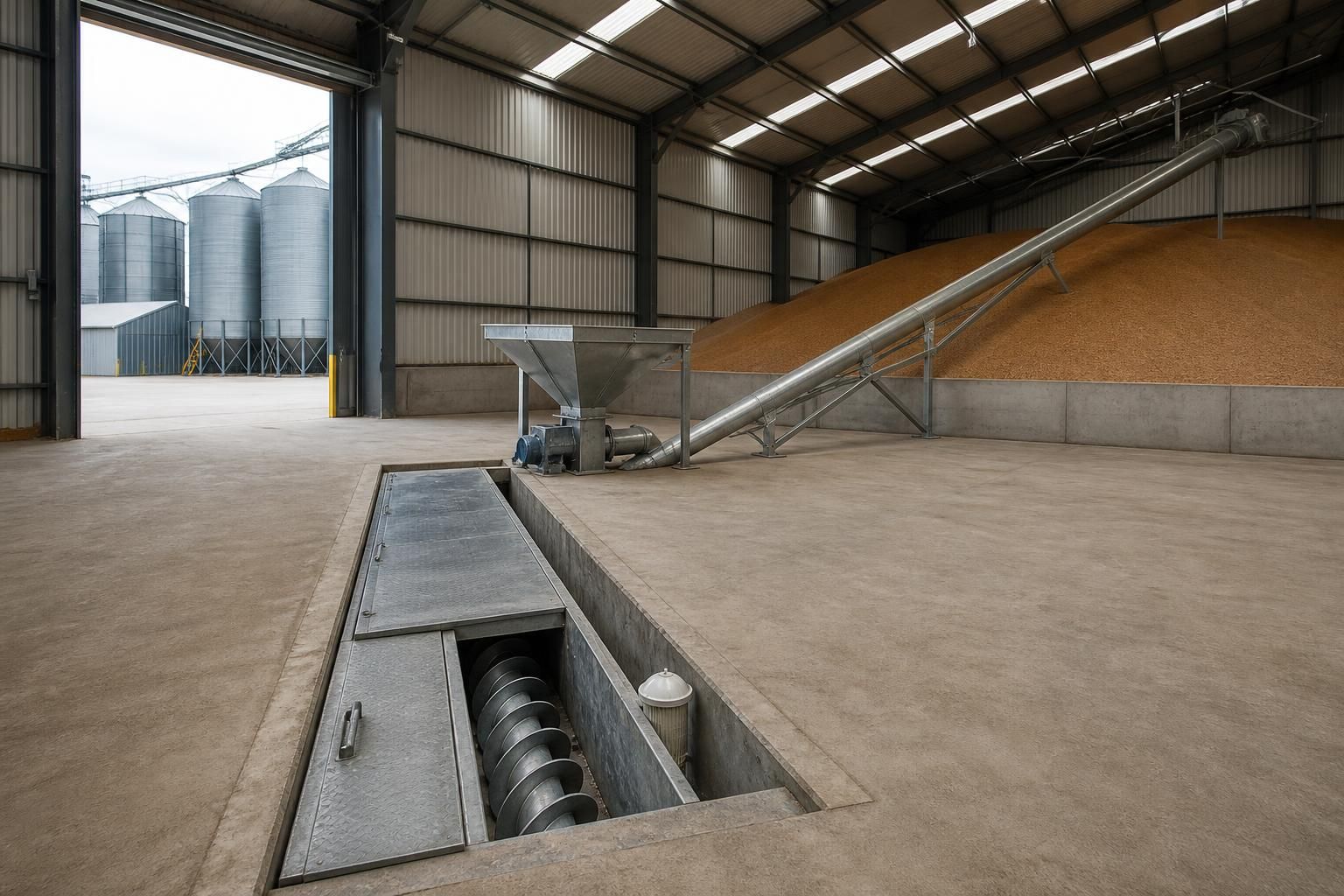
Choose the auger arrangement for the grain movement required. A fixed tube auger may transfer grain from an intake hopper into a store, while a floor auger can collect grain from a channel or sump during unloading. Mobile augers can serve more than one storage area, but they need suitable positioning space, stable support and a clear connection to the intake or discharge equipment. Where grain has to be raised to a higher loading point, an inclined auger may be used, although the angle affects throughput, power demand and the potential for grain damage.
The selection should take account of the grain type, the required transfer rate, conveying distance, inclination and the number of movements expected during the season. A larger or faster auger is not automatically the best option: excessive speed can increase impact and friction, while an undersized unit may restrict the rest of the handling system. The auger should therefore be matched to the intake, storage and outloading equipment so that one part of the system does not become a bottleneck.
At the intake, the auger normally connects to a hopper or receiving point. The transition into the auger should allow grain to enter evenly across the flight, without creating a dead zone where material accumulates. A grille or suitable intake protection can help prevent stones, tools and other large objects entering the conveyor. Slide gates or shut-off arrangements may be used to regulate the flow and isolate the auger when the store is not receiving grain.
At the other end, the auger can discharge into a store, another conveyor, a drying system or a vehicle-loading point. The outlet should be arranged to prevent grain from falling against obstructions or building up around the discharge. Where grain is distributed across a store, the outlet arrangement may need to be moved or connected to separate discharge points. The transition pieces must be properly supported and sealed, since poorly supported connections can transmit vibration and allow dust or rainwater to enter.
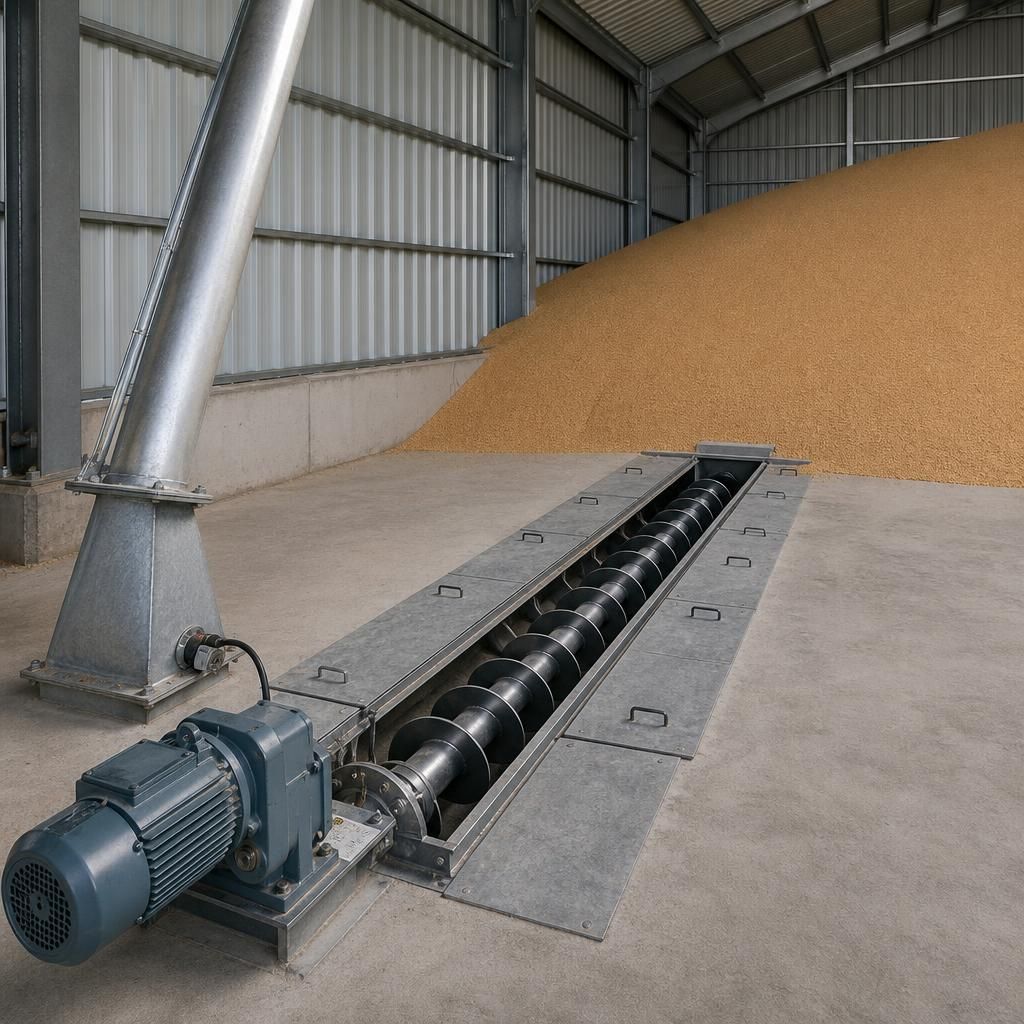
Floor integration is particularly important for fixed augers. A below-floor auger may be installed in a purpose-designed channel leading to a collection sump. The channel requires a robust cover system capable of withstanding the loads imposed by people, handling equipment or vehicles using the store. Covers should remain secure during operation but be removable when inspection or maintenance is necessary. The channel and sump should also be designed to avoid water collection, as damp grain and standing water can damage equipment and affect stored grain quality.
Where the auger is installed above floor level, its supports must be coordinated with the steel frame, walls or independent posts. The supporting arrangement needs to accommodate the dead weight of the conveyor, the weight of grain inside it, motor forces and vibration during starting and stopping. Openings through walls or cladding should be detailed with suitable weatherproofing and should not compromise the building’s structural or environmental performance.
Grain flow should be controlled through the auger rather than relying solely on the motor. Typical controls can include an inlet gate, level sensors, motor overload protection and interlocks with connected conveyors. Interlocking prevents an upstream conveyor from continuing to feed when a downstream unit has stopped. A common operating sequence is to start the discharge equipment first, then the auger feeding it, and to stop the feed before the downstream equipment. This reduces the amount of grain left in the system and helps prevent blockages.
Emergency-stop controls should be positioned where operators can reach them without approaching moving parts. Guards are required around exposed flights, shafts, couplings and drive components, and access covers should not be capable of being opened casually while the auger is running. The electrical installation, control panel and any hazardous-area considerations should be assessed in relation to grain dust, the building layout and the applicable workplace and electrical safety requirements.
Inspection and maintenance points should be designed in from the start. Bearings, drive assemblies, seals and the auger flight are subject to wear, particularly where grain contains abrasive material or foreign particles. Inspection panels and isolation points allow these components to be checked without dismantling unrelated parts of the store. The flight should not be allowed to run against the casing, and unusual noise, vibration, overheating or reduced output should be investigated rather than treated as normal operation.
Hygiene also affects the design. Residual grain left in a tube, sump or transition can attract pests, encourage mould growth and contaminate a subsequent crop. The system should therefore have practical points for emptying and cleaning, with smooth internal transitions wherever possible. If different grains or treated seed are handled, the cleaning procedure may need to be more comprehensive to prevent cross-contamination.
For a new steel-framed grain store, the auger arrangement should be shown alongside the building elevations, floor plan and structural details. This allows openings, support steelwork, floor channels, hopper locations, electrical routes and maintenance provisions to be resolved before fabrication. Incorporating these interfaces at the design stage produces a more coherent installation than cutting through the completed structure or improvising supports after the store has been erected.
Level monitoring should be coordinated with the auger so incoming grain cannot continue unnoticed as the store fills. A high-level sensor or alarm can be positioned where the grain pile is expected to reach its maximum safe level, with the control system arranged to stop the incoming conveyor or auger when that point is reached.
Sensor location matters because grain does not always form an even surface, particularly when it enters from one side or through a fixed outlet. The design should account for the filling pattern and include a separate means of confirming the store level before loading continues. This helps prevent overfilling, protects roof-level equipment and reduces the risk of grain obstructing access or ventilation points.