
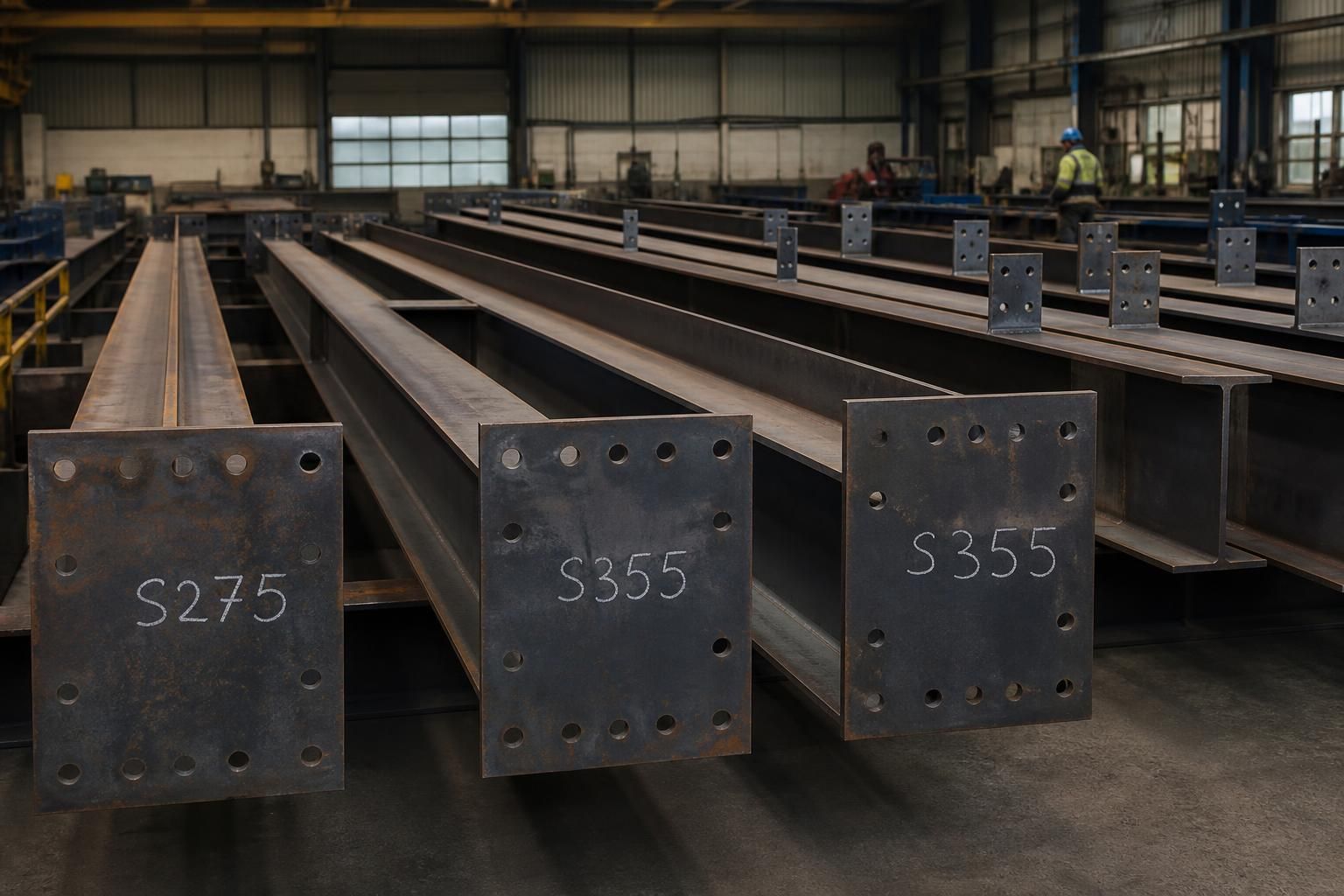
What do S275 and S355 steel grades mean?
S275 and S355 are European structural steel grades: the “S” means structural steel, while the number identifies the grade’s minimum yield strength in megapascals. S355 has a higher minimum yield strength than S275, so the appropriate grade depends on the design loads, member sizes and project requirements.
The practical distinction between S275 and S355 is the level of stress a steel section can withstand before it begins to yield. That distinction affects structural calculations, section selection, connection design and, in some cases, the amount of steel required. The grade is only one part of the specification: thickness, product standard, toughness classification and fabrication requirements must also be considered.
Yield strength and tensile strength
Yield strength is the key value associated with the S275 or S355 designation. It describes the stress at which permanent deformation begins. Once a member yields, it will not fully return to its original shape when the load is removed. S355 is assigned a higher minimum yield strength than S275, allowing a suitably designed member to resist greater calculated stress.
Tensile strength is different. It describes the stress range associated with the maximum load the steel can carry in tension before fracture. A grade has both yield-strength and tensile-strength requirements, and the relevant design checks use the appropriate value rather than treating the grade number as a general measure of every property.
What the designations mean
- S identifies structural steel.
- 275 and 355 identify the grade’s nominal minimum yield-strength class in megapascals, subject to the product standard and thickness range.
- Additional letters and numbers can identify impact-toughness requirements or other delivery conditions.
The grade is normally specified alongside the relevant European product standard. For common hot-rolled structural products, EN 10025-2 is the principal standard covering non-alloy structural steels. A complete material specification may therefore include the grade, subgrade, product form, thickness and delivery condition rather than simply stating “S275” or “S355”.
Why thickness matters
The number in the grade designation should not be read as a guaranteed yield-strength value for every thickness. The permitted minimum yield strength can reduce as the nominal thickness increases. This is because thicker material can behave differently during manufacture and under load. Structural calculations must therefore use the value applicable to the actual product thickness and the governing standard.
This is particularly important when comparing an S275 and S355 option for columns, rafters, beams, plates or connection components. The result should be based on the properties of the specific section or plate being considered, not on the grade name alone.
How S275 and S355 are commonly selected
- S275 can be appropriate where the calculated loads, spans, stability checks and connection forces can be met with that grade and the selected member sizes.
- S355 may be considered where higher design resistance could reduce the required section size, assist with demanding load cases or provide more flexibility in the structural arrangement.
- Neither grade is automatically the correct choice. The lower-strength option may be suitable and more efficient for one member, while the higher-strength option may be justified for another.
Using S355 does not automatically permit every member to become smaller. Deflection, buckling, lateral stability, vibration, fire design, connection capacity and serviceability may govern before the steel’s yield strength does. A lighter or smaller section can also have different fabrication, erection and connection implications. The selected grade must therefore be checked as part of the complete design rather than chosen solely to maximise strength.
Subgrades and impact toughness
Suffixes such as JR, J0 and J2 relate to impact toughness testing at specified temperatures. Impact toughness indicates the material’s ability to absorb energy under a sudden loading condition and helps address the risk of brittle fracture. It is not the same property as yield strength.
The required subgrade can depend on factors including the design temperature, steel thickness, stress level, detail category, loading conditions and consequences of failure. A project specification may require a particular subgrade even when either S275 or S355 would satisfy the basic strength calculation.
Welding and fabrication considerations
Both grades are widely used in fabricated structural steelwork, but the selected material must be compatible with the approved welding and fabrication procedure. Weldability is influenced by the steel’s chemical composition, thickness, heat input, joint detail and restraint. Higher-strength steels can require closer control of welding conditions and preheating than a lower-strength equivalent, depending on the material certificate and procedure.
Fabricators should verify the material designation and certification before cutting, drilling or welding. Traceability is important where different grades are used on the same project, particularly for plates, connection components and heavily loaded members. Fabrication should follow the project specification and the applicable execution requirements, including any inspection and testing provisions.
What grade should a project use?
The decision should be made by the responsible structural designer using the building’s loads, geometry, spans, support conditions, environmental exposure, fire strategy, connection details and fabrication constraints. The design drawings and steelwork specification should state the required grade and subgrade for each relevant product, rather than leaving the choice to material procurement.
For a building kit or bespoke structural steelwork package, the grade should be coordinated across the calculations, design drawings, fabrication information and material orders. A competent designer or steelwork specialist can then confirm whether S275, S355 or a combination of grades is appropriate for the members and details involved.
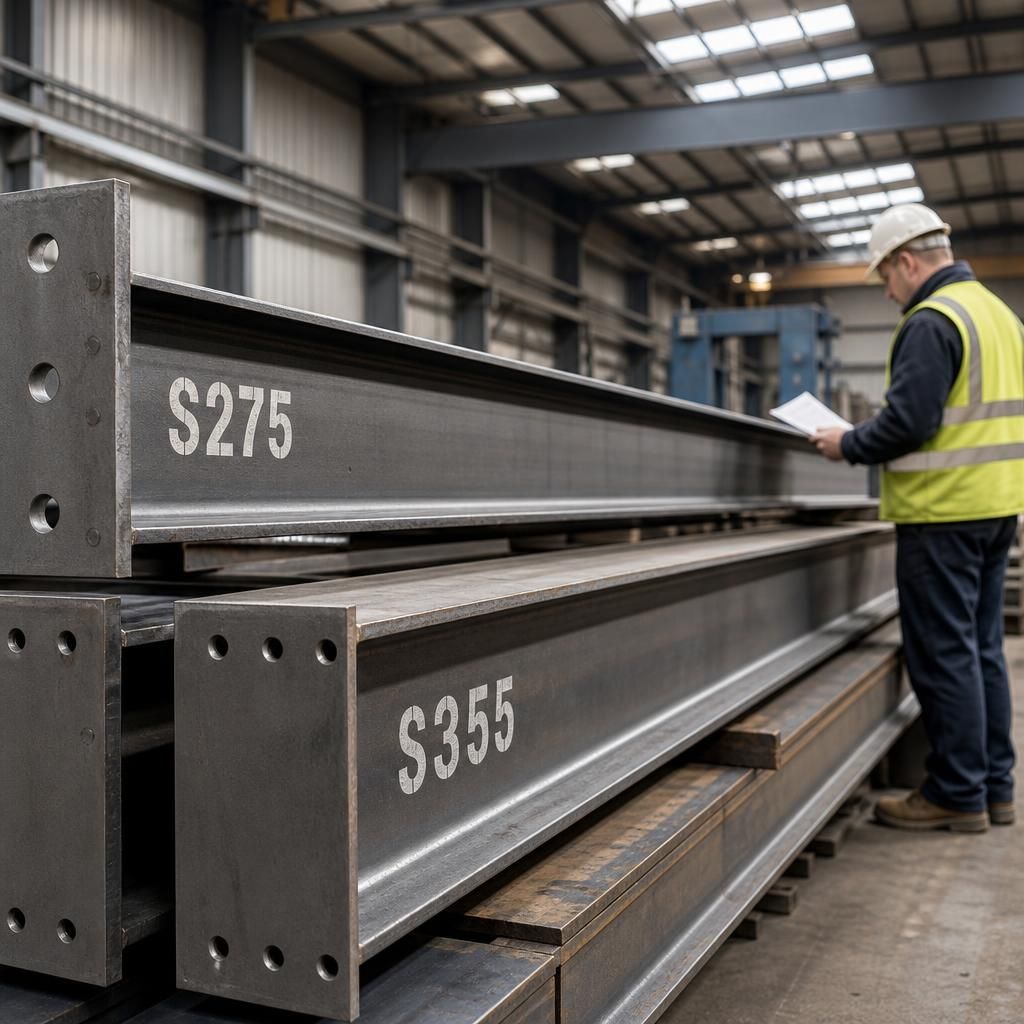
S275 and S355 describe the steel’s strength class; they do not, by themselves, specify how the material will perform in its finished environment. The designation does not state whether the steel has been painted, galvanised or given another corrosion-protection system. That requirement must be selected separately according to exposure conditions, including moisture, condensation and agricultural or industrial contaminants.
The same distinction applies to fire performance. Choosing S355 instead of S275 does not make a member fire-resistant, and the grade alone does not determine its required fire protection. Coatings, encasement, section characteristics and the project’s fire strategy are separate design considerations. A complete steelwork specification should therefore record the grade alongside the required corrosion protection and fire-treatment provisions.