
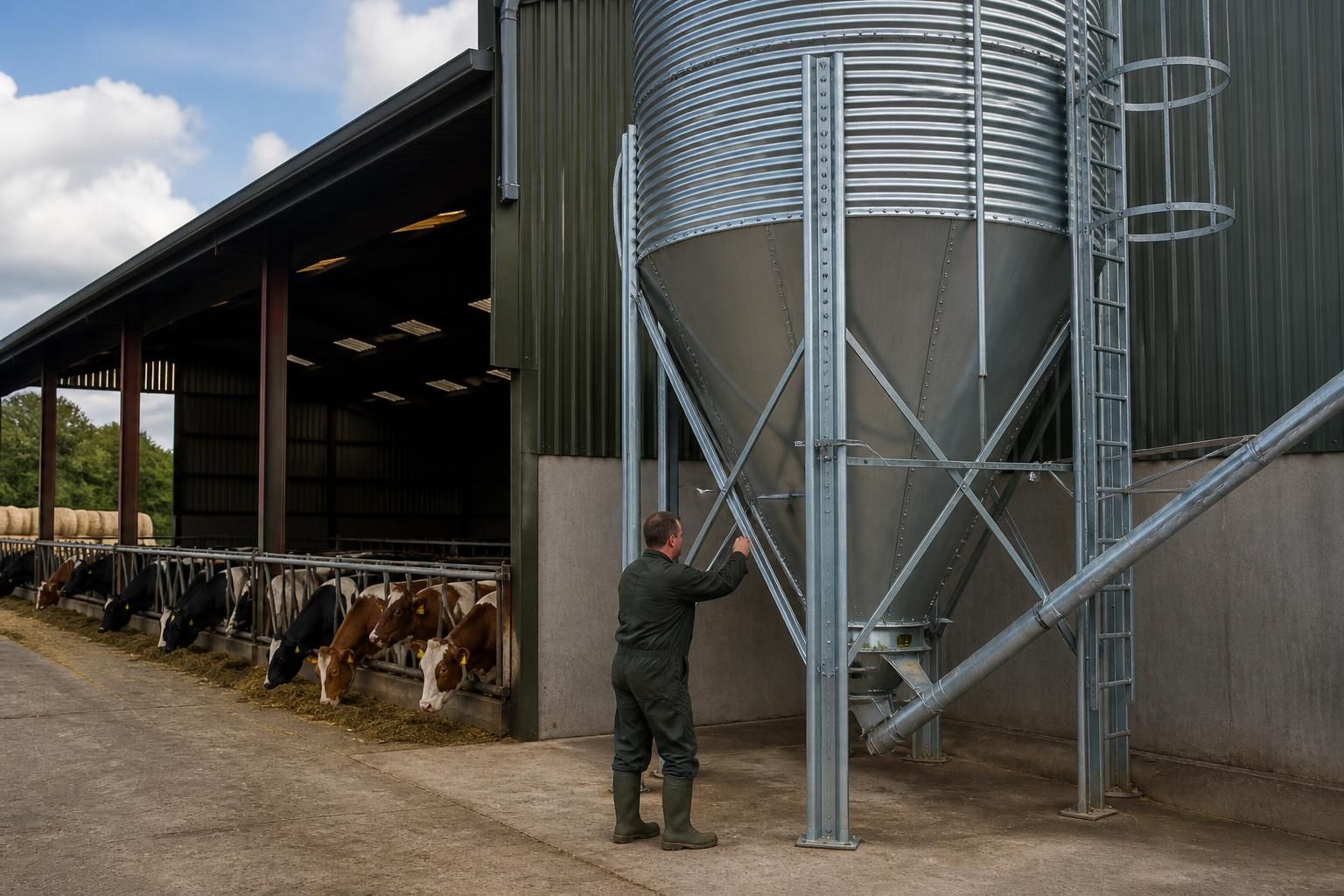
What capacity should a cattle feed bin provide?
A cattle feed bin should provide enough usable capacity for the herd’s feed requirement between deliveries, with allowance for feed density, delivery intervals and a practical reserve. Calculate demand from the number and type of cattle, their daily ration and the intended refill frequency, then select a bin whose usable volume meets that requirement without relying on its maximum stated capacity.
The right cattle feed bin capacity is the one that accommodates the planned feed volume in its usable storage zone while fitting the farm’s delivery, handling and site arrangements. Capacity should therefore be assessed in both tonnes and cubic metres: the mass required depends on the herd’s ration, while the physical bin size depends on the feed’s bulk density.
Start by establishing the quantity of feed used during a normal storage cycle. A practical assessment should include:
- the number and class of cattle being fed;
- the quantity of each feed used per day;
- changes between winter, housing and grazing periods;
- the number of deliveries that can be scheduled and the size of the delivery vehicle;
- the amount of feed that must remain available before the next delivery; and
- any separate feed streams that need their own storage compartments.
Feed density is a key sizing factor. Two feeds occupying the same bin volume may have different weights, and a feed’s density can also vary with moisture content, processing and composition. Ask for the relevant bulk-density information for the feed being stored, then compare the required mass with the bin’s stated capacity in tonnes. If only a volume is given, convert the expected feed weight using the applicable density rather than assuming that all materials fill the bin in the same way.
Do not treat the maximum advertised capacity as the amount that can always be used. The usable capacity is affected by the fill level, the outlet arrangement, the roof and cone geometry, and the need to keep material flowing correctly. A bin should not normally be selected so that routine deliveries depend on filling it to an impractical level. The working capacity should also allow for safe inspection and for the normal variation that occurs in delivery quantities.
Delivery logistics can be as important as herd demand. A bin may need greater capacity if deliveries are infrequent, access is restricted, or the supplier delivers in larger loads. Conversely, an unnecessarily large bin can leave feed stored for longer than intended, occupy more space and increase the consequences of poor stock rotation. Capacity should be matched to the feed’s storage characteristics and the farm’s method of ordering, rather than chosen solely because a larger vessel appears more flexible.
Where several feeds are used, a single large bin is not automatically the best arrangement. Separate bins can prevent different materials from being mixed, support more accurate ration control and make stock levels easier to monitor. The decision should take account of the number of feed types, their individual usage rates and whether each material requires different discharge or handling arrangements.
It is also sensible to assess the highest likely requirement rather than sizing only for an average day. Consider herd expansion, changes in housing numbers, seasonal feeding patterns and periods when deliveries may be delayed by farm operations or access conditions. Any allowance should be deliberate and proportionate: excessive spare capacity is not a substitute for a properly planned delivery schedule.
Before confirming a capacity, check the proposed bin against the site and equipment that will serve it. The overall height must suit the available clearance, while the outlet must align with the auger, pneumatic conveying system or other feed-handling equipment. The foundations, vehicle approach, discharge position and access for inspection also need to accommodate the chosen dimensions. A capacity that works on paper may be unsuitable if the bin cannot be filled, discharged or maintained efficiently.
A useful specification should record the required working mass, the feed’s assumed density, the desired refill point and the maximum acceptable delivery quantity. Supplying these details to the designer allows the bin dimensions, cone configuration, outlet and supporting steelwork to be considered together. For a bespoke steel-framed agricultural installation, planning drawings and fabrication information can then be coordinated with the wider building and handling layout.
Review the calculation whenever the herd size, ration, delivery pattern or feed type changes. Capacity is not a fixed property of the farm: it is part of a wider storage system that must remain compatible with feed usage, vehicle access and the way the ration is handled.
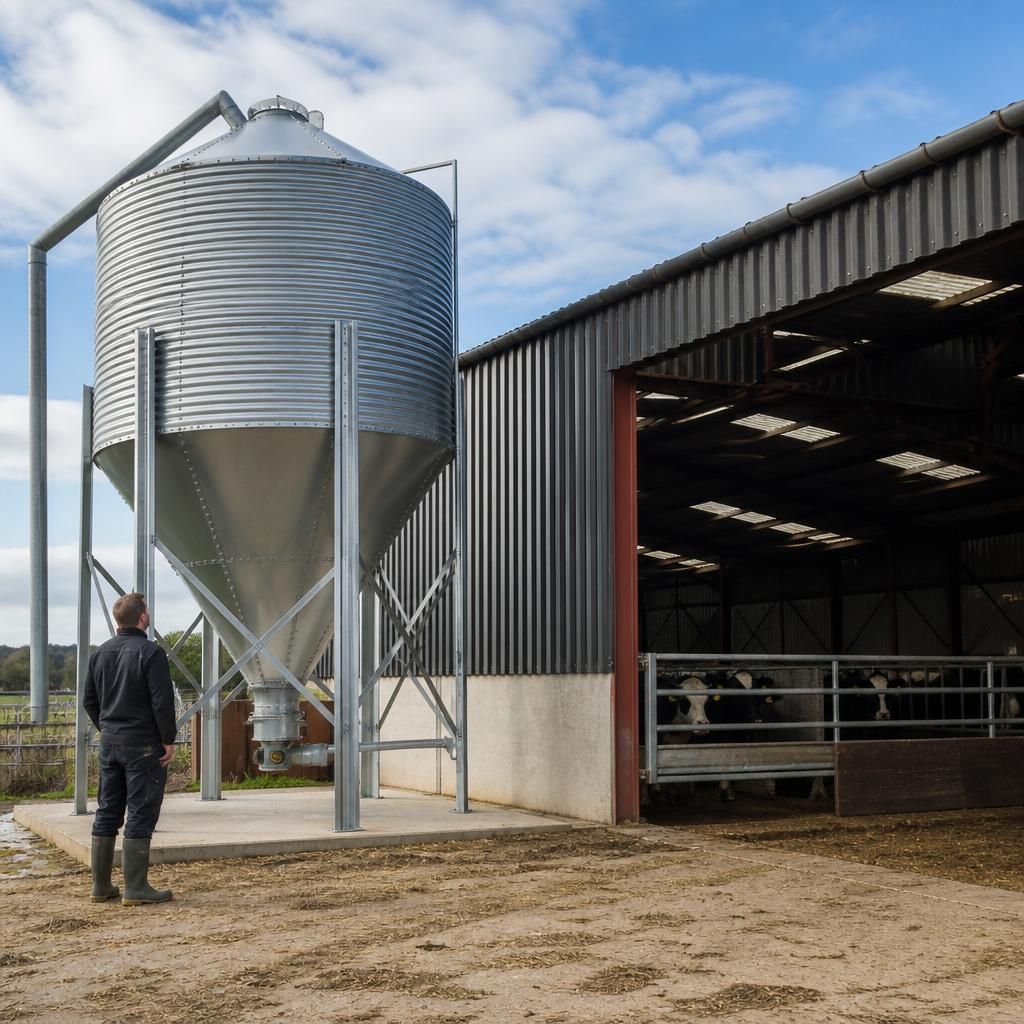
Validate the proposed cattle feed bin capacity against actual feed usage before finalising the specification. Review delivery records, weighbridge information and ration sheets over the periods when demand is highest, then compare the quantity delivered with the amount consumed before the next refill. This can reveal changes in intake or ordering practice that an average daily estimate may miss.
Record the result as a working capacity rather than simply selecting a nominal bin size. The specification should show the expected feed quantity at the normal refill point, the minimum stock level to retain and the quantity that can be accepted safely during a delivery. This gives the bin designer a clear basis for selecting dimensions and avoids relying on assumptions about how much material the vessel can practically hold.
Discuss Your Cattle Feed Bin Capacity Requirements
Discuss your cattle feed bin capacity requirements with Buildings UK Ltd, providing details of your herd, feed types and delivery arrangements. Their team can use this information to develop a bespoke storage specification suited to your farm layout and handling system.