
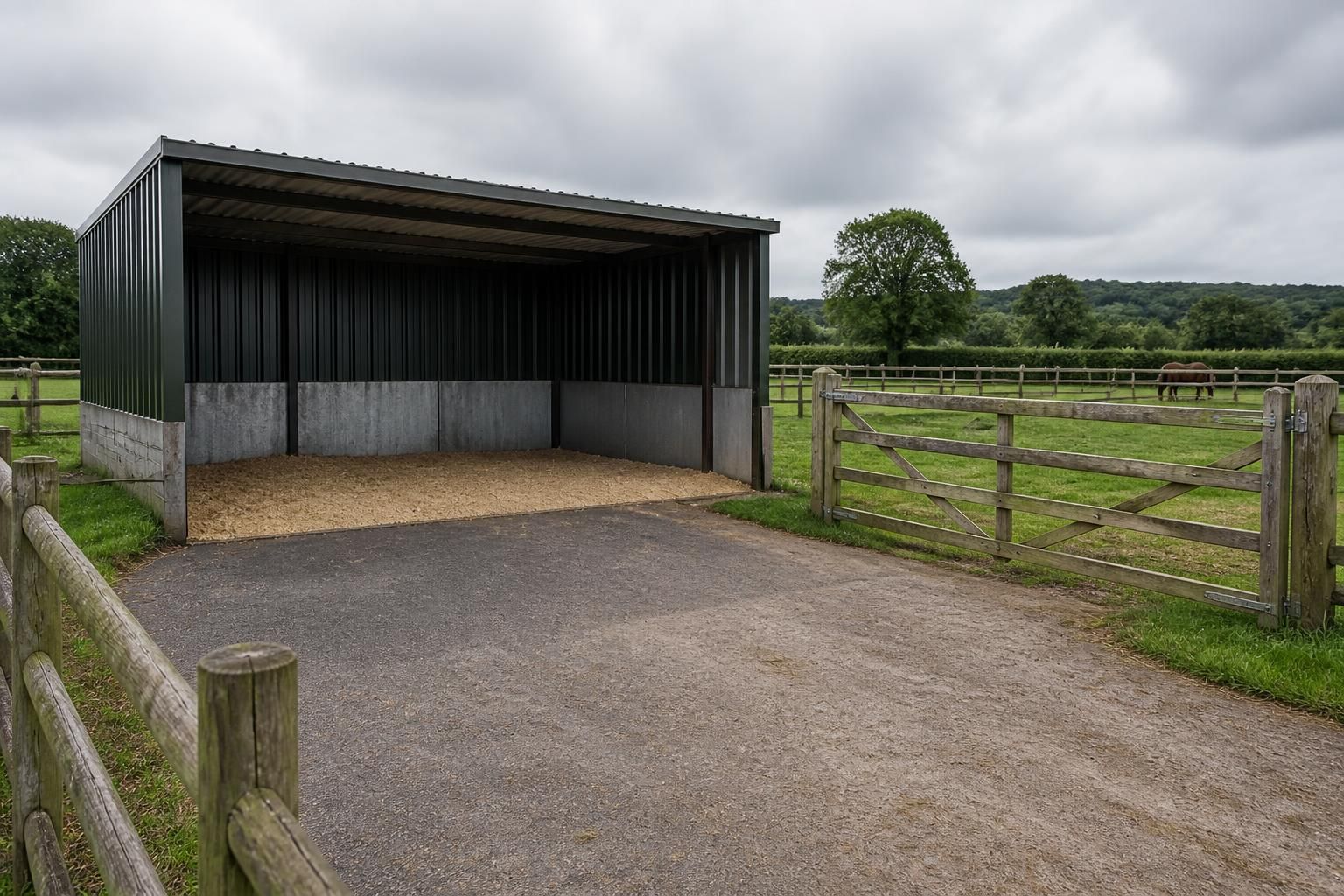
What access arrangements do field shelters for horses require?
Field shelters for horses require a clear, safe approach for the horses using them, together with suitable vehicle access for delivery, maintenance and removal of bedding or equipment. Plan a firm, well-drained route, adequate turning space and gates that open safely without creating sharp corners, bottlenecks or obstructions around the entrance.
Access arrangements for a field shelter should accommodate both the horses entering and leaving the building and the people, vehicles and equipment needed to maintain it. The layout must provide sufficient clearance for the intended animals and machinery, prevent conflict between them, and allow the entrance area to be inspected, cleaned and used safely in all normal conditions.
Horse access should be predictable and unobstructed. Horses are more likely to use a shelter confidently when the entrance is easy to see and does not force them through a narrow passage. Avoid placing posts, water troughs, feed stations, stored materials or fencing immediately beside the opening. Any adjoining fence line should guide movement rather than create a dead end or a sharp change of direction.
The entrance size should be assessed against the type and number of horses using the shelter. A small opening may restrict movement for larger animals, while an excessively open frontage can provide less protection from driving rain and may make it harder to control access. Where several horses share the building, consider whether subordinate animals could be trapped inside or prevented from leaving by others. A broad, open-fronted arrangement may suit some groups, whereas a managed doorway or partitioned entrance may be more appropriate in other settings.
Doors and gates need careful specification. They should be capable of being secured without leaving projecting catches, loose chains or other items at head and shoulder height. Hinges and stops should be positioned so that an animal cannot become caught against them. Sliding doors must have their running gear and retaining arrangements protected from impact, while hinged gates should swing in a direction that does not obstruct the main movement area. Any closing mechanism should be usable by the handler without requiring them to stand in a confined position beside the horse.
Where the shelter has a closable entrance, plan how it will be opened during routine handling, veterinary attention or an unexpected evacuation. A person should be able to reach the fastening safely, and the arrangement should not depend on equipment being left across the entrance. If horses are separated into groups, internal divisions should retain a practical route to the outside rather than creating enclosed pockets.
Vehicle access is a separate design consideration. The route used by tractors, trailers or delivery vehicles should be assessed for the actual equipment that will visit the site. Consider the vehicle’s overall width, height, turning movement and loading position, as well as overhead branches, low cables, boundary features and changes in ground level. If machinery must approach the shelter entrance, its route should not require horses to share the same space during loading, unloading or maintenance.
It is often preferable to provide a service side or working edge that can be reached without driving directly into the area occupied by the horses. This can make bedding removal, repairs and the movement of feed or equipment more controlled. Where a vehicle must enter the building, the structural opening, eaves clearance and internal layout should be checked against the machinery before fabrication. The access arrangement should also allow the driver to see people and animals around the building.
Consider the following points during site planning:
- Keep the immediate entrance zone free from feed, tools, bedding stacks and temporary fencing.
- Ensure boundary gates can be secured against unintended movement and do not interfere with the shelter entrance.
- Use transitions between different surfaces that do not create a pronounced lip or loose material at the threshold.
- Position lighting, if provided, so that it does not create strong glare or confusing shadows at the doorway.
- Provide enough working room for a handler to lead, turn or release a horse without standing between the animal and a fixed object.
- Review access after placing troughs, hay racks, partitions and other fixtures, since these can reduce the usable entrance area.
Access should also be reviewed as part of the site’s emergency arrangements. The route from the shelter should remain usable if a horse needs to be removed quickly, and a secondary means of release may be appropriate depending on the building design and management plan. Fire risk, neighbouring stock, public access and the position of other field infrastructure should all be considered rather than treating the shelter as an isolated structure.
For a new steel-framed shelter, these requirements should be communicated at the design stage. A site plan can show the relationship between the entrance, field boundaries, service routes and existing features, while elevation and fabrication drawings can confirm the proposed openings and structural clearances. This helps ensure that the finished building works for both daily horse management and the equipment required to look after it.
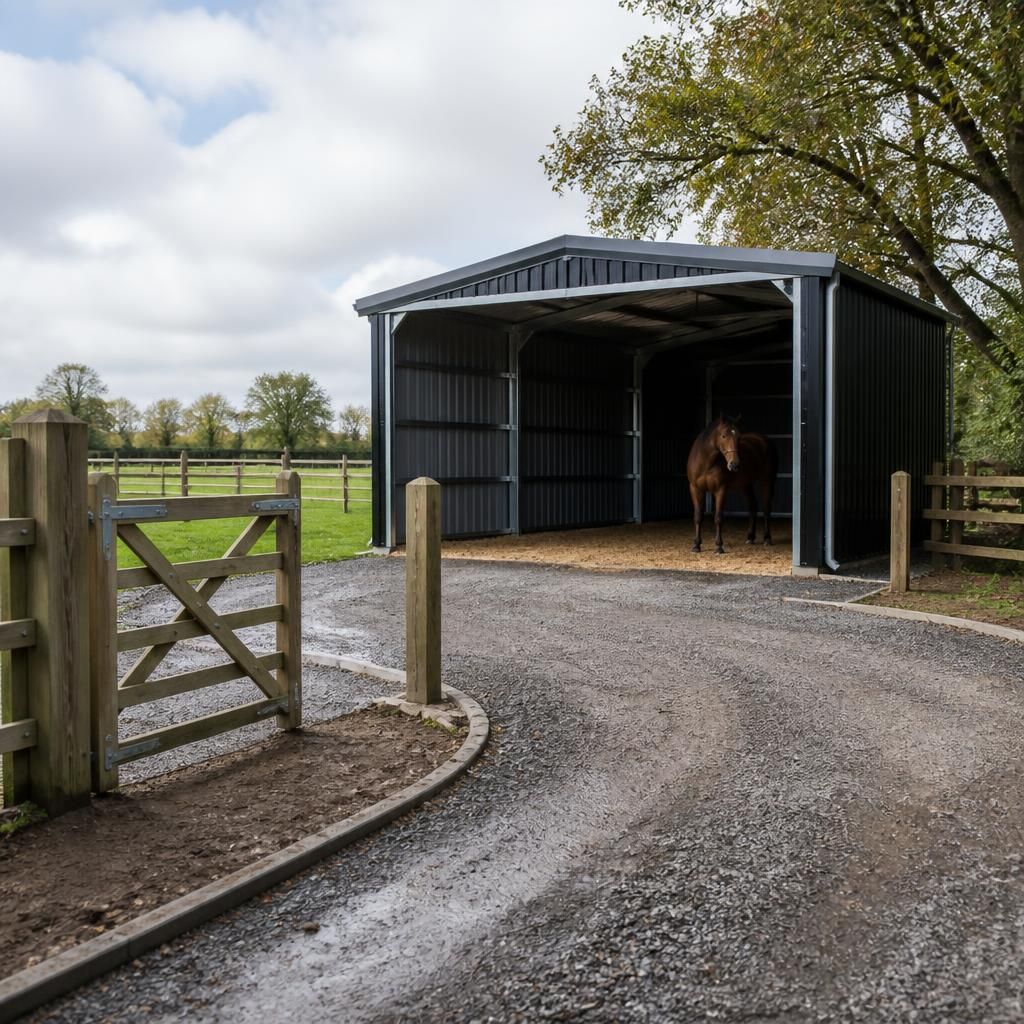
Gate sequencing is an important part of access planning for a field shelter. Where vehicles pass through more than one field gate, the openings should align as far as the site allows, with enough space between them to open and secure each gate without standing in the vehicle’s path. Avoid placing a gate immediately in front of the shelter entrance, as this can create a pinch point for horses and make vehicle movements harder to control.
A separate pedestrian or horse-handling route can reduce conflicts with tractors and delivery vehicles. It should connect the normal field entrance with the shelter without requiring a handler to lead a horse across the vehicle route. The arrangement should also leave a suitable place for a vehicle to wait while a gate is opened, rather than stopping on a public road, narrow track or directly outside the horse entrance.