
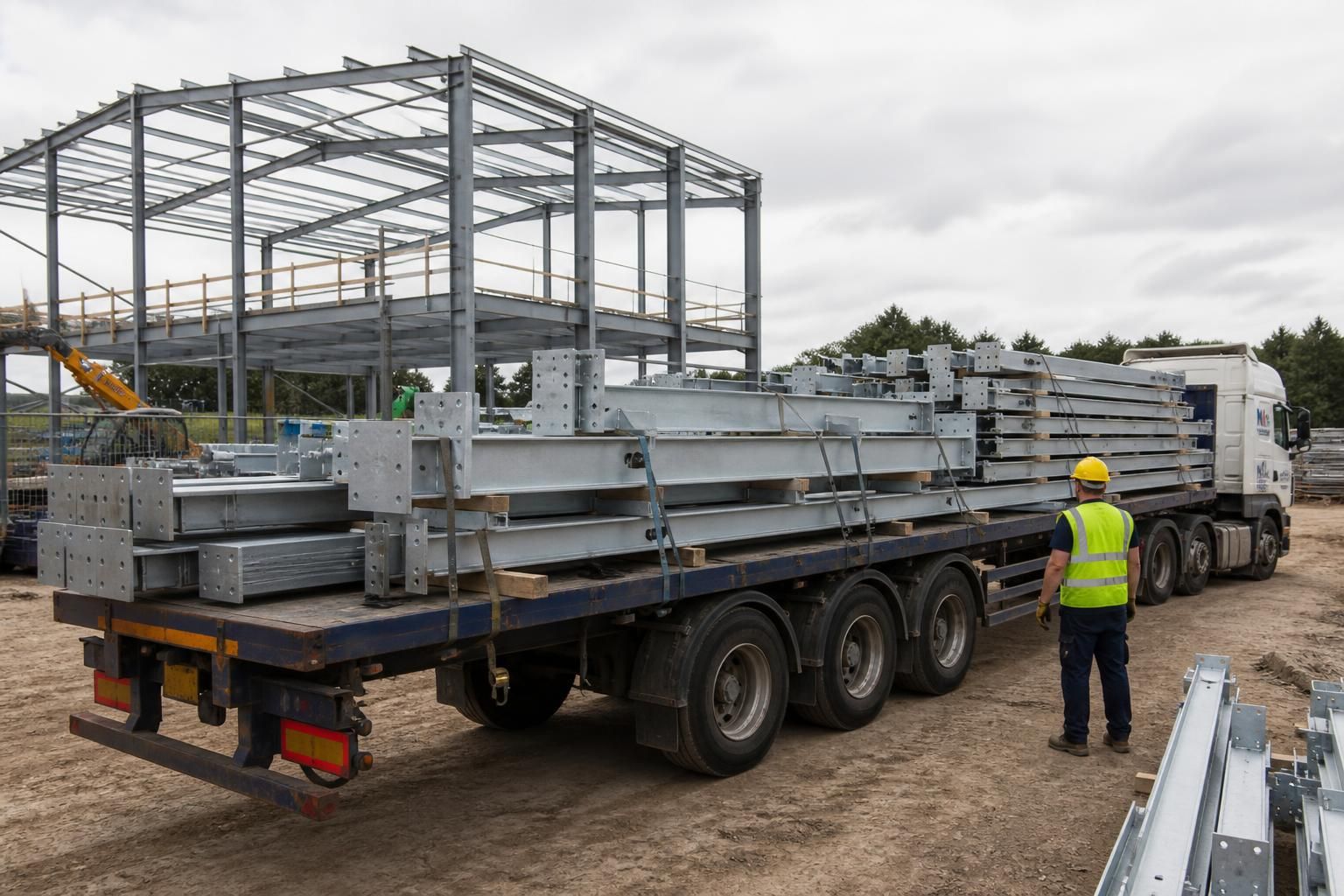
How are industrial steel buildings delivered to site?
Industrial steel buildings are delivered as prepared structural components, with transport and unloading coordinated to suit the site access, storage areas and construction sequence. Once the site is ready, the steelwork can be checked against the fabrication drawings and erected by the customer’s team or through a full erection service.
Industrial steel buildings are delivered in a planned sequence that links fabrication, transport, site access and erection. The objective is to move each structural component from the manufacturing facility to the project safely, keep it identifiable on arrival and avoid creating unnecessary handling or disruption on the site.
Before transport is arranged, the delivery plan should reflect the building’s final design and the way it will be assembled. Information normally considered includes:
- the site address and the most suitable approach route;
- the width, height and surface condition of access roads and entrances;
- any bridges, low clearances, restricted turns, gates or overhead services;
- where a delivery vehicle can stop without obstructing public roads or site operations;
- the available area for temporary placement of steelwork;
- the order in which frames, secondary steelwork and associated components are required; and
- any restrictions caused by neighbouring buildings, working machinery or other contractors.
Accurate site information is particularly important for larger industrial projects. A vehicle may be able to reach the site entrance but still be unable to position itself where unloading is needed. If access is narrow or the ground is unsuitable for heavy vehicles, the delivery arrangement may need to be reviewed before the steel leaves the factory.
The steelwork is normally grouped and identified to support the construction process. Primary frame members, purlins, side rails, bracing, connection components and other fabricated items need to remain distinguishable after unloading. The fabrication drawings provide the reference for matching components to their intended location, while suitable labelling and grouping reduce the risk of searching through mixed materials during erection.
Unloading requires a stable, prepared area and appropriate lifting equipment. The receiving party should establish who is responsible for providing lifting machinery, operators and any temporary storage arrangements. Loads should not be placed where they could interfere with access, excavation work, drainage, fire routes or other construction activities. Steel members also need to be supported in a way that prevents avoidable damage, instability or contact with standing water and contaminated ground.
Site preparation affects delivery as much as the vehicle route does. Foundations, holding-down bolts and concrete work should be complete and sufficiently ready for the planned stage of construction. The positions of the foundations and bolt groups should be checked against the design information before steelwork is assembled. Any discrepancy is easier to investigate before unloading and erection than after several connected members are in place.
On arrival, the delivery should be checked against the accompanying information and the fabrication drawings. Useful checks include:
- confirming that the expected bundles and principal members have arrived;
- examining steelwork for visible transport or handling damage;
- checking that connection materials and smaller components have been kept with the correct part of the structure;
- recording any missing, damaged or incorrectly identified items; and
- keeping the delivery documentation available for the erection team.
Steel should be protected from unnecessary exposure and stored so that water can drain away. Members should not be left directly on soft ground, and stacked materials should be arranged so that they cannot roll, topple or become inaccessible. Good housekeeping is important because small connection items and bracing components can be difficult to locate once they are mixed with unrelated materials.
For a building kit, the customer or appointed contractor generally controls the receiving arrangements, unloading equipment and on-site storage. Where a full erection service has been selected, the delivery and assembly activities can be planned as one operation, subject to the agreed project arrangements. In either case, the delivery plan should make clear which party is responsible for traffic management, lifting operations, checking the load and reporting discrepancies.
Delivery dates should be considered alongside the construction sequence rather than treated as an isolated transport booking. If steel arrives before foundations, lifting equipment or the erection team is ready, it may need to be stored and handled again. Conversely, a late or incomplete delivery can interrupt assembly. Coordinating the load order with the intended erection sequence helps limit double handling and keeps the project organised.
Weather and ground conditions can also affect the practical delivery arrangements. Soft surfaces may require temporary improvement, while poor visibility, standing water or strong winds can make unloading and lifting unsuitable. These are site management considerations for the responsible contractor, who must ensure that the work area, lifting equipment and personnel are suitable before operations begin.
A well-managed delivery therefore depends on more than transporting steel to an address. It requires reliable design information, a realistic access assessment, suitable unloading arrangements, secure storage and clear responsibility between the building supplier, customer and erection team. These measures allow the delivered components to be identified, inspected and introduced into the construction sequence without avoidable handling or site disruption.
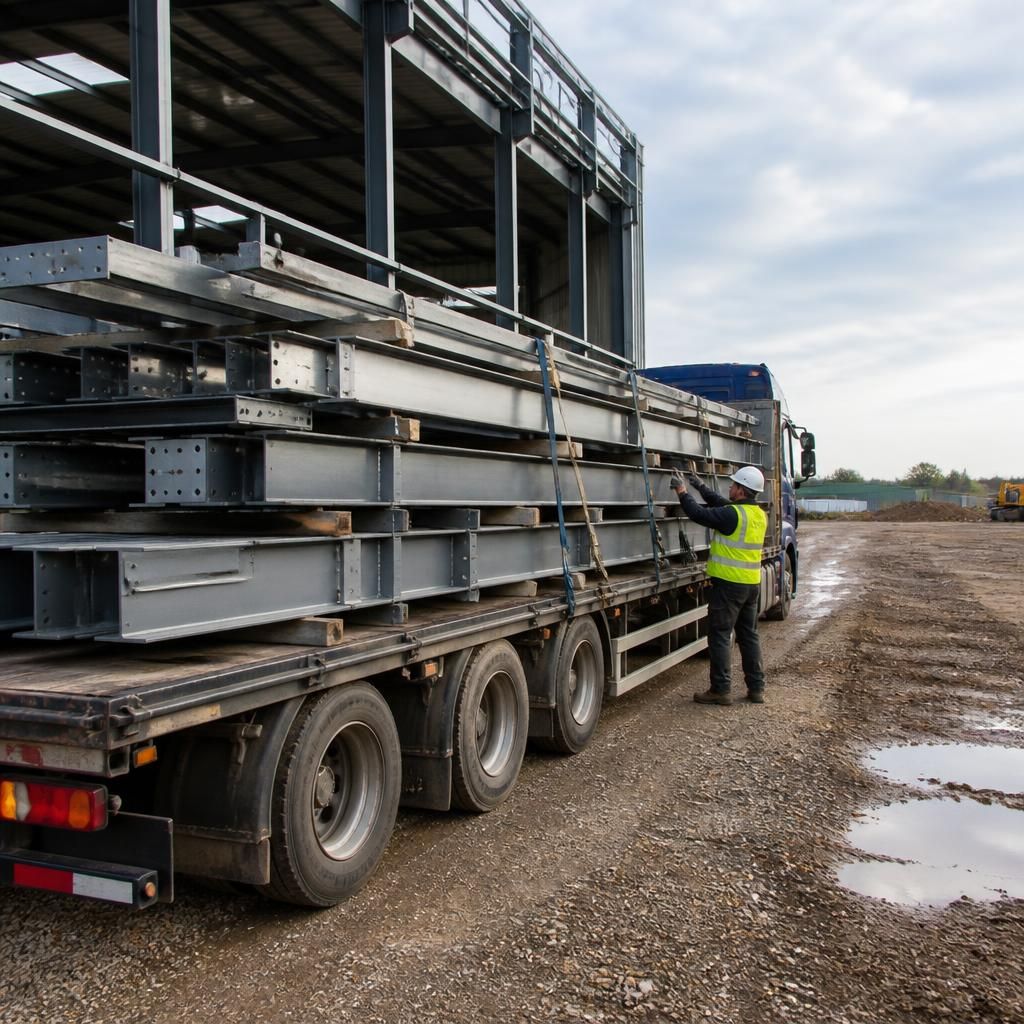
An industrial steel building is not usually transported to site as a complete structure. It is delivered as separate fabricated members that can be loaded, moved and positioned safely, then assembled in accordance with the approved fabrication drawings.
This approach allows the transport load to be arranged around the building’s construction sequence. Main frame members form the primary structure, while purlins, side rails, bracing and connection components are delivered as associated parts. Once the relevant components are available on site, the erection team can progressively connect them into bays and complete the structural frame.
Delivering the building in this form also makes it easier to identify individual items and investigate any issue before that part of the frame is installed. The delivery is therefore an organised transfer of labelled structural components, rather than a single finished building being placed on the site.