
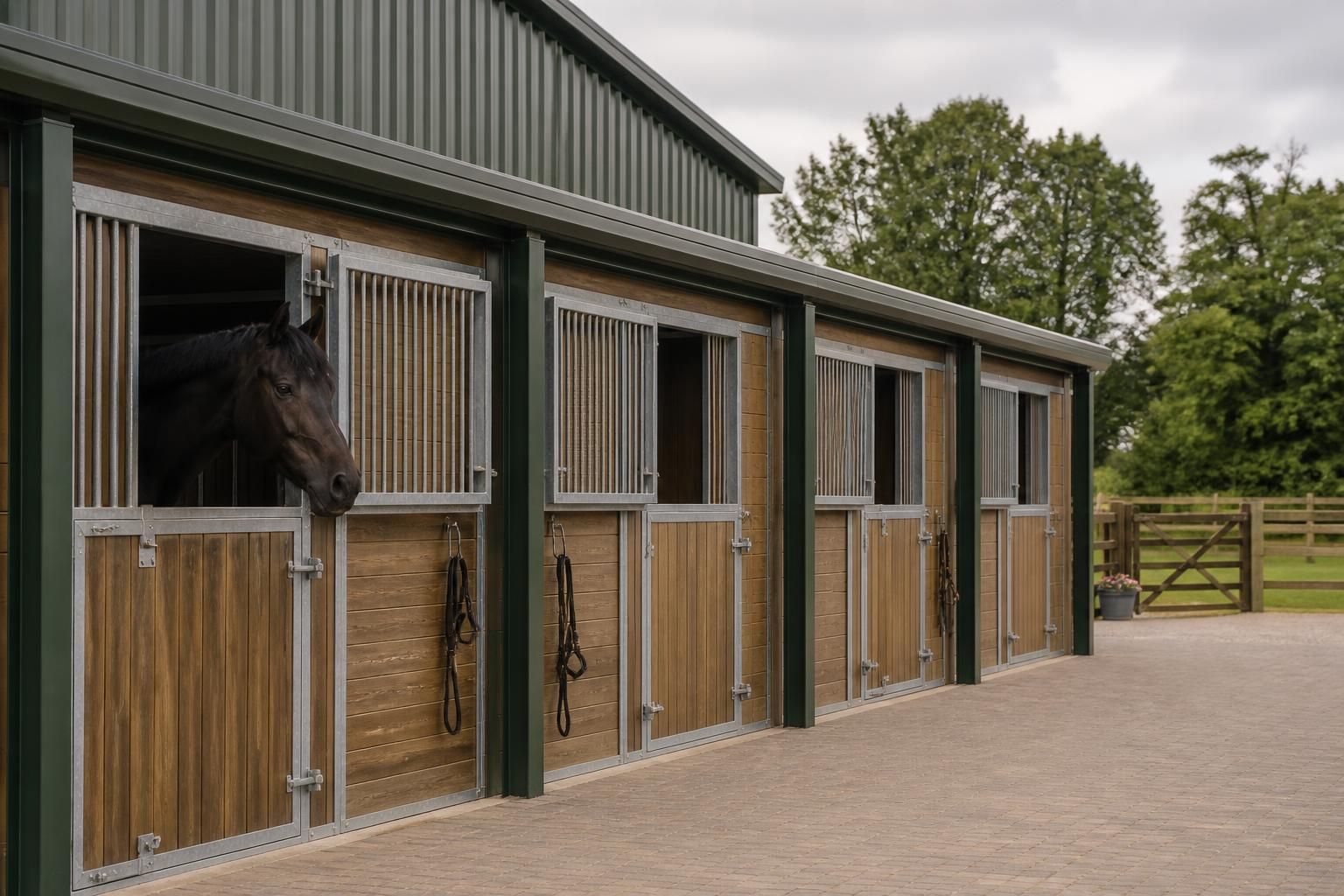
What are the advantages of steel-framed stables?
Steel-framed stables provide a strong, durable structure that can be designed around horse welfare, practical daily use and the requirements of the site. They also offer flexible layouts, straightforward maintenance and the option to accommodate future changes more readily than many traditional construction methods.
The main advantages of steel-framed stables are their efficient structural design, accurate manufacture and ability to create well-organised equestrian accommodation without relying on numerous internal load-bearing walls. A correctly specified steel frame provides a dependable basis for stable blocks, loose boxes, covered yards, tack rooms, feed stores and associated working areas.
Efficient use of internal space
Hot rolled steel sections can carry roof and cladding loads over relatively wide spans. This allows larger areas to remain open and usable, which is valuable for stable aisles, grooming spaces, vehicle access and storage. Internal partitions can be positioned according to the stable plan rather than being dictated by the structural frame, making it easier to separate horses, staff areas, feed storage and equipment.
Resistance to common building problems
Steel is not vulnerable to rot, insect attack or the moisture-related deterioration associated with some untreated organic materials. The frame itself is also non-combustible. These characteristics can reduce some of the risks associated with agricultural and equestrian environments, although the complete building still requires suitable fire precautions and appropriate choices of cladding, insulation, doors and internal finishes.
Protection against corrosion remains important. Steelwork should be specified with a suitable protective finish for the building’s exposure and internal conditions. Good drainage, controlled condensation and adequate ventilation are also necessary, particularly where the building houses horses, wet bedding, wash-down areas or stored feed.
Accurate, controlled manufacture
Steel frames are manufactured from detailed structural information, allowing sections, connections and fixing points to be prepared before delivery to site. This provides greater control over dimensions and alignment than construction methods that depend heavily on cutting and adjustment during installation. Fabrication drawings also give the project team a clear reference for coordinating the frame with doors, rooflights, cladding, partitions and services.
That level of preparation is useful when an equestrian building has several connected functions. For example, the design may need to coordinate horsebox access with stable doors, position roof drainage away from circulation routes, or allow a covered link between boxes and a yard. Identifying these relationships during design helps avoid conflicts during construction.
Efficient construction and installation
Much of the structural work is completed in a controlled manufacturing environment, with the prepared components then assembled on the foundations. This can make the construction sequence more predictable than building the entire structure from raw materials on site. It can also limit the amount of cutting, welding and alteration required around the finished stable area.
The frame is only one part of the installation, so the groundworks, foundation design, cladding, roof, doors and internal fittings must all be coordinated. A site assessment is important because ground conditions, access for delivery and assembly, drainage levels and the intended use of the building can affect the final specification.
Design freedom for different equestrian uses
A steel frame can support many enclosure arrangements, including open-fronted shelters, enclosed stable blocks, American-style layouts, yard buildings and combined storage structures. External materials and internal fittings can be selected to suit the location and use, while the structural arrangement can accommodate features such as large access doors, rooflights and covered circulation areas where these are included in the design.
For architects and agricultural clients, this separation between the primary frame and the building envelope can simplify the development of a coordinated specification. The frame, roof, walls, openings and internal stable fittings can be considered as connected but separate elements, helping each part to perform its intended function.
Clear documentation for planning and construction
A bespoke steel-framed stable design can be supported by planning elevation drawings and isometric fabrication blueprints. These documents help show the proposed external appearance, principal dimensions, openings and structural arrangement. They are useful when discussing the project with a planning authority, preparing quotations or checking that the building meets the requirements of the site.
Planning approval, building regulations and agricultural or equestrian land-use considerations are separate from the choice of frame. A steel structure does not automatically remove the need for permission or technical checks. The proposed use, location, size, access, drainage and relationship with neighbouring land should be assessed before construction.
Overall, steel-framed stables are advantageous because they combine efficient spanning, controlled fabrication, resistance to rot and pests, and broad enclosure options in one structural system. Their performance depends on the quality of the design, corrosion protection, foundations, ventilation, cladding and installation, so the frame should be specified as part of a complete building rather than considered in isolation.
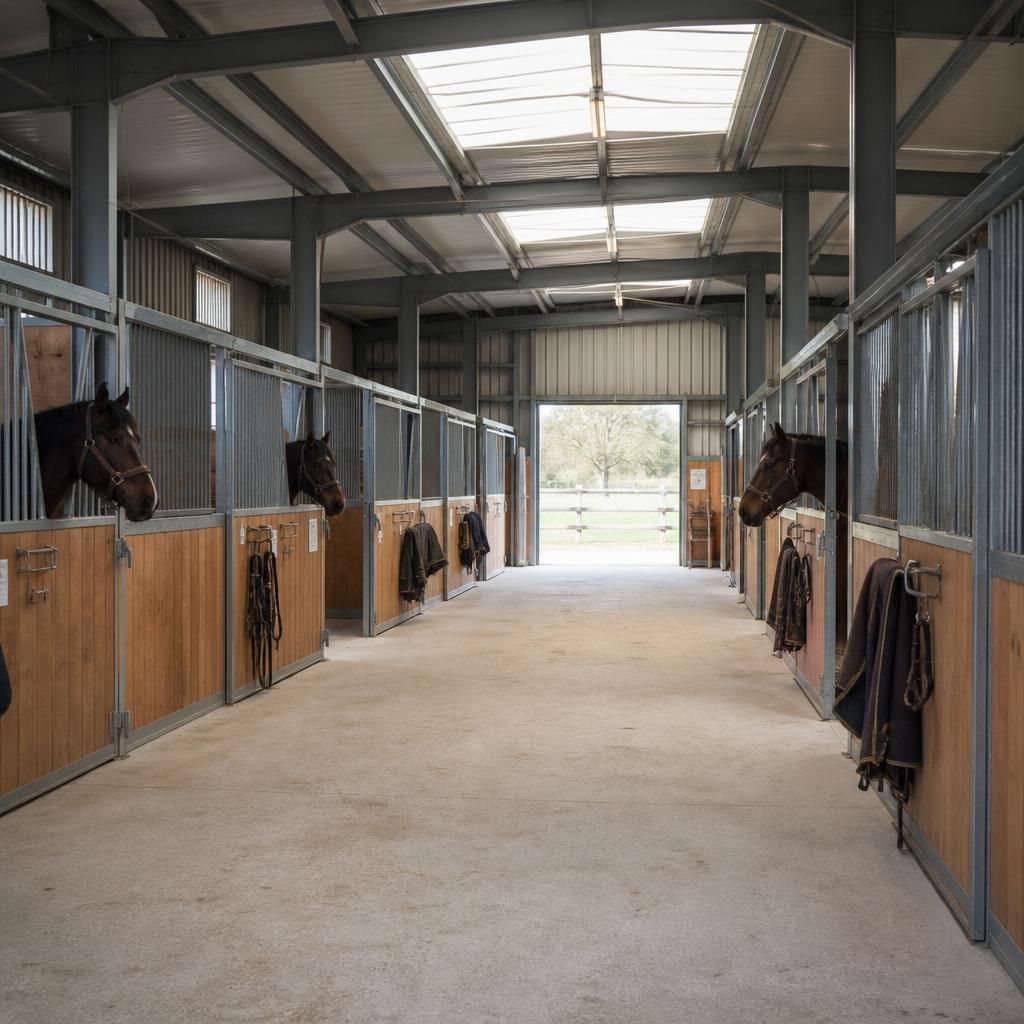
A further advantage of steel-framed stables is the ability to create a consistent layout across separate buildings or future phases of an equestrian site. The same structural approach can be used for stable blocks, covered links, storage areas and yard-facing elevations, helping the buildings work together visually and practically. This is particularly useful where accommodation is developed in stages or where new facilities need to relate to an existing stable complex.