
What maintenance access do feed bins require?
Feed bins require planned, safe access to inspection points, filling and discharge equipment, and any areas needing cleaning or repair. Access arrangements may include suitable ladders, platforms and working clearances, with isolation procedures and confined-space controls considered where entry could be required.
Maintenance access for a feed bin is a planned combination of external inspection points, service routes and safe working areas that allows routine checks, cleaning and equipment repairs without relying on improvised climbing or unsuitable access equipment. The arrangement should be designed around the bin’s height, shape, stored material, roof and outlet equipment, together with the tasks that must be carried out during its working life.
Routine access points: A bin normally needs practical access to the roof area, filling equipment, vents, level indicators, filters, inlet pipes, discharge mechanisms and any inspection hatches. These points should be reachable without stepping onto fragile components or standing on curved surfaces. Where an operator needs to read an indicator, clear a blockage or inspect a connection regularly, the access route should be permanent and positioned so that the person can work without leaning excessively.
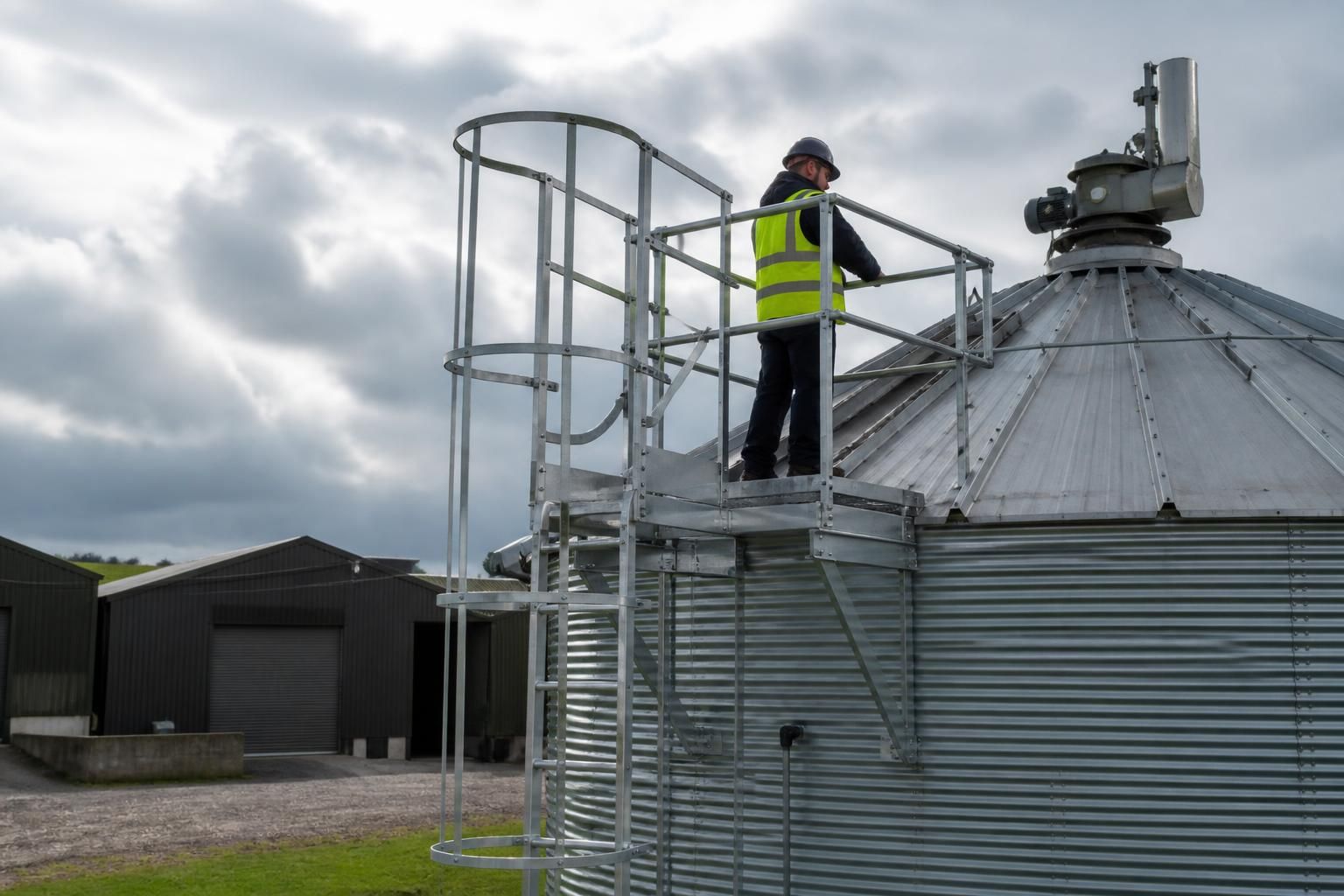
Working platforms and edge protection: Platforms should provide enough space for the task, not merely a place to stand. Guardrails, intermediate protection and toe boards help prevent falls and stop tools or components being dropped onto people below. Gates should not create an opening that leaves the user exposed while moving between a ladder and platform. Surfaces should provide grip in wet, dusty or icy conditions, and the layout should avoid contact with moving augers, conveyors and other machinery.
Ladders and climbing routes: The access system should offer a consistent route from ground level to each service location. Fixed ladders, rest points and transition areas need to be selected according to the height and frequency of use. The ladder should not finish beside an unprotected edge, pipework or discharge equipment. Handholds at the top and bottom help with transitions, while the surrounding space should allow a person carrying only essential tools to climb without snagging clothing or equipment.
Ground-level service access: Not all maintenance should take place at height. Discharge cones, slides, valves, gearbox drives, flexible connections and clean-out doors should be arranged so that they can be inspected and operated from a stable position wherever practicable. A firm, level surface around these components makes it easier to use tools, remove guards and handle replacement parts. Vehicle routes and loading areas should be kept separate from the standing area used for servicing, reducing the risk of collision during maintenance.
Roof and weather protection: Roof access requires particular care because roof sheets, vents and seals may be damaged by inappropriate foot traffic. The design should identify designated walking areas and prevent users from having to cross unsupported or slippery panels. Drainage, weather seals and corrosion-prone joints should remain visible or reachable for inspection. If maintenance is likely to be carried out in poor weather, the access arrangement should account for rain, wind, ice and reduced visibility rather than assuming dry conditions.
Cleaning and inspection arrangements: Access hatches and clean-out openings should be positioned so that residues can be identified and removed using the intended cleaning method. Their size and location should reflect the bin’s internal geometry and the equipment used by the operator. Dead areas around outlet cones, ledges, stiffeners and inlet pipes deserve particular attention because accumulated feed can affect product quality, obstruct flow or attract pests. A maintenance plan should record which areas are inspected, how often they are checked and what condition requires corrective work.
Mechanical and electrical equipment: Motors, gearboxes, sensors, control panels and isolation points need enough room for testing, adjustment and component removal. Guards must be removable for servicing but securely refitted before operation. Cable routes should be protected from abrasion, moisture, rodents and contact with moving machinery. Isolation devices should be clearly identified and positioned where they can be reached before work starts, without requiring a person to approach an active hazard.
Planning the access arrangement: Before installation, list every foreseeable task, including inspecting seals, checking vents, lubricating drives, replacing sensors, clearing outlet equipment and removing worn parts. Mark each task on the building or equipment layout, then confirm that the person, tools and replacement components can reach the work position safely. Consider lighting, drainage, headroom, lifting requirements and the space needed to remove covers or guards. Access should also be checked against the final position of adjacent buildings, conveyors, vehicles and stock-handling equipment.
Internal entry should be avoided where an external inspection or cleaning method can complete the task. If entry is genuinely necessary, it requires a separate, documented risk assessment and a controlled permit-to-work process covering isolation, atmospheric conditions, rescue arrangements and supervision. Maintenance access is therefore best treated as part of the feed bin design, rather than as an accessory added after the bin and surrounding equipment are installed.
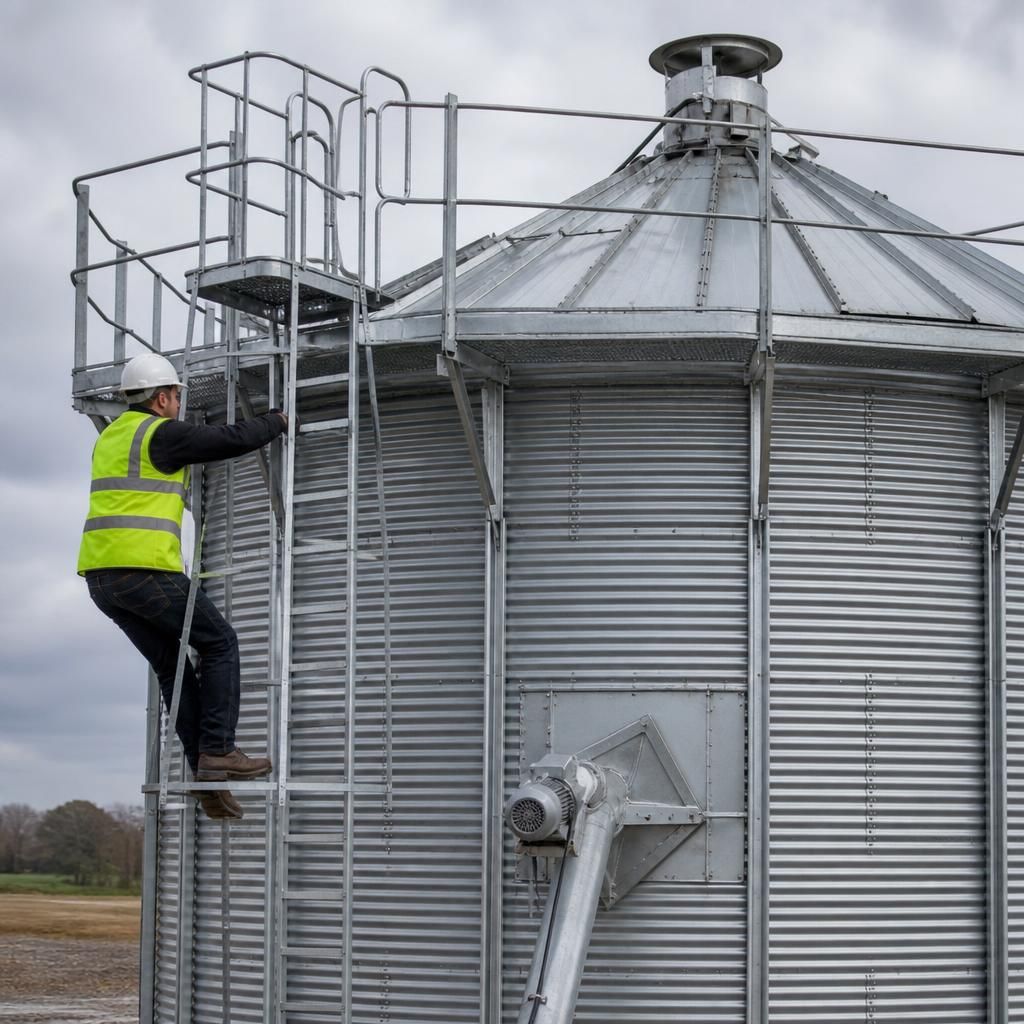
Feed bin maintenance access should cover major component replacement as well as routine inspection. A permanent ladder may provide access for checks, but it may not give enough room to replace a roof section, filter, motor or discharge component safely.
Where temporary equipment such as scaffolding or a mobile elevating work platform may be needed, the site should provide suitable hardstanding, clear approach routes and adequate overhead clearance. Plan where removed parts will be lowered, how tools will be secured and how people will be kept outside the work area. This prevents a repair from depending on improvised equipment or creating new hazards around the bin.