
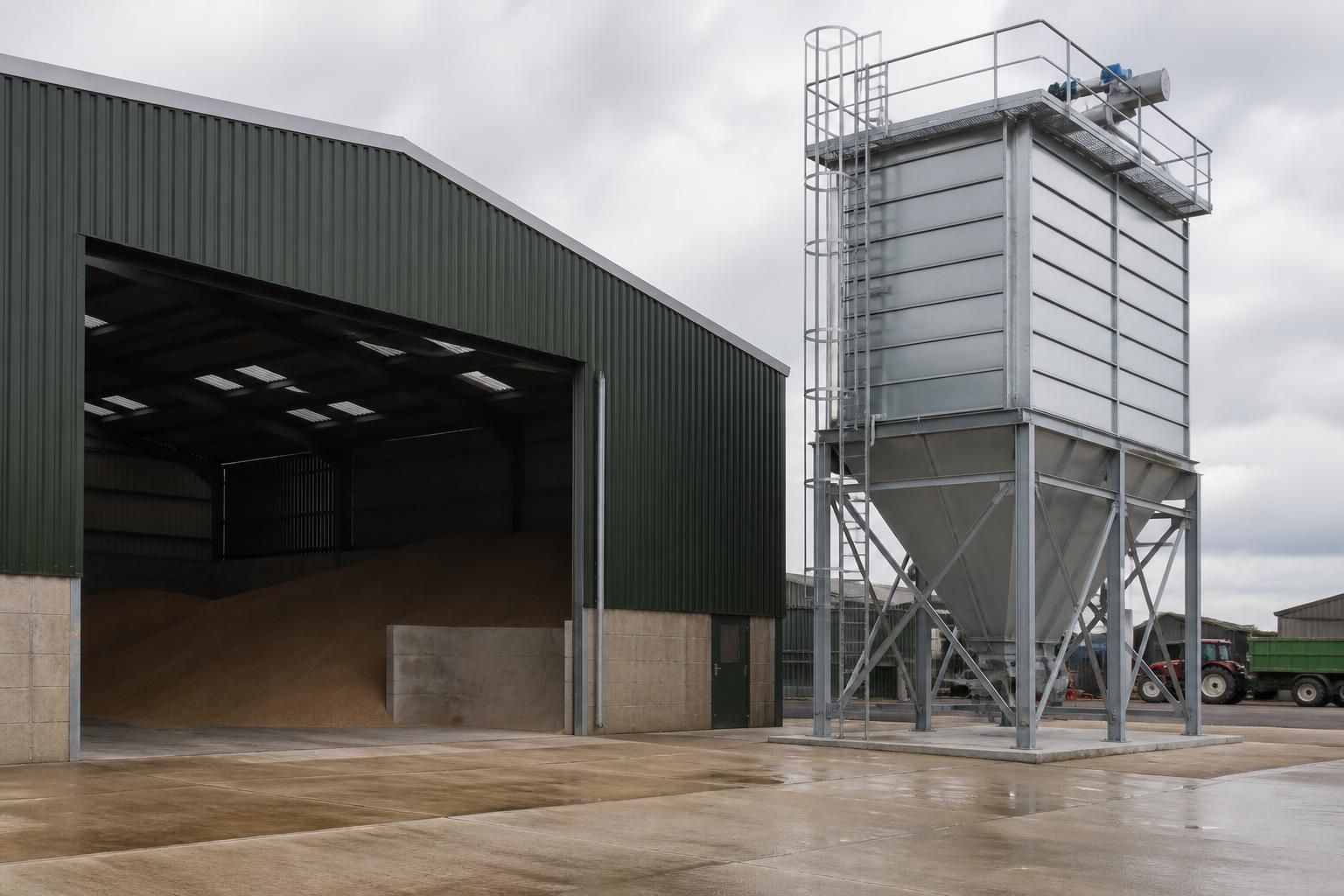
When is a grain hopper preferable to a conventional grain store?
A grain hopper is preferable when you need contained, weather-protected storage with straightforward loading and controlled discharge, particularly where available space or regular mechanised handling makes a store less practical. A conventional grain store is generally more suitable for larger, flexible floor storage or when different crops need to be kept in separate bays.
A grain hopper is preferable when grain needs to be stored in a compact, enclosed system with efficient intake and discharge, rather than spread across a building floor. The decision depends on the type and volume of grain, how often it will be moved, the available site, and whether the priority is controlled handling or maximum storage flexibility.
Choose a grain hopper where handling efficiency is central to the operation. Grain can be loaded from above and discharged through the hopper outlet, reducing the need for loaders or other equipment to form and remove floor piles. This can suit farms that regularly move grain into feed systems, outloading equipment, dryers or transport vehicles. The sloping base also supports more complete emptying than a flat store, although residual material may still need to be cleaned out.
A hopper can also be a practical option where the site has limited usable space. Its vertical arrangement makes better use of the available footprint than a shallow floor store with the same overall capacity. This may be useful where circulation routes, existing buildings or yard layout restrict the area available for a new storage structure. The supporting steelwork, access equipment and conveying arrangements still need to be incorporated into the design, so the footprint should be assessed as part of the complete installation rather than looking only at the hopper itself.
Contained storage is another reason to favour a hopper. A suitable enclosure can help protect grain from rain, birds and other external contamination. It does not remove the need to receive grain in good condition: grain entering storage must have an appropriate moisture content and temperature, and the system should be monitored for heating, condensation, insect activity and deterioration. Ventilation or aeration requirements should be established during design, particularly where grain will be held for an extended period.
A conventional grain store is usually the stronger choice when flexibility matters more than automated handling. A floor store can accommodate different crop types, changing batch sizes and irregular loads without being tied to fixed hopper compartments. It can also be used for other agricultural purposes when grain storage is not required, subject to the building design, hygiene arrangements and any relevant operational constraints. This adaptability can be valuable for a diversified farm or an operation whose cropping plans change from year to year.
Segregation needs should be considered carefully. Separate hoppers can provide dedicated storage, but adding compartments, conveyors and discharge points increases the complexity of the installation. A conventional store may make it easier to create temporary bays or alter the arrangement of stored crops, although maintaining physical separation and preventing cross-contamination depends on good housekeeping and suitable handling equipment.
Cost should be assessed across the whole system rather than by comparing the storage vessel or building alone. A hopper may require supporting steelwork, ladders or platforms, intake equipment, conveyors, discharge controls and suitable foundations. A floor store may require a larger building and more mobile handling equipment. The relevant comparison is the total capital cost, operating effort, maintenance access, energy use and expected pattern of grain movements over the life of the installation.
- A hopper is more likely to suit the operation where: grain movements are regular, controlled discharge is important, space is restricted, and the stored material can be managed through a defined intake and outlet system.
- A conventional store is more likely to suit the operation where: large floor areas are available, crop types or batch sizes vary, temporary segregation is needed, or the building may have to serve other uses.
Before selecting either option, review the complete flow of grain from collection through intake, drying or conditioning, storage, sampling and outloading. Check vehicle access, conveyor routes, working clearances, inspection points, cleaning arrangements and safe access for maintenance. Planning for these details early helps prevent a storage choice that appears suitable on capacity but is difficult to operate in practice.
In simple terms, a grain hopper is preferable for a defined, space-efficient storage and handling process, while a conventional store is preferable where adaptability and floor-space versatility are the main requirements. The right solution is the one that matches the farm’s crop rotation, handling method, storage duration and future use of the site.
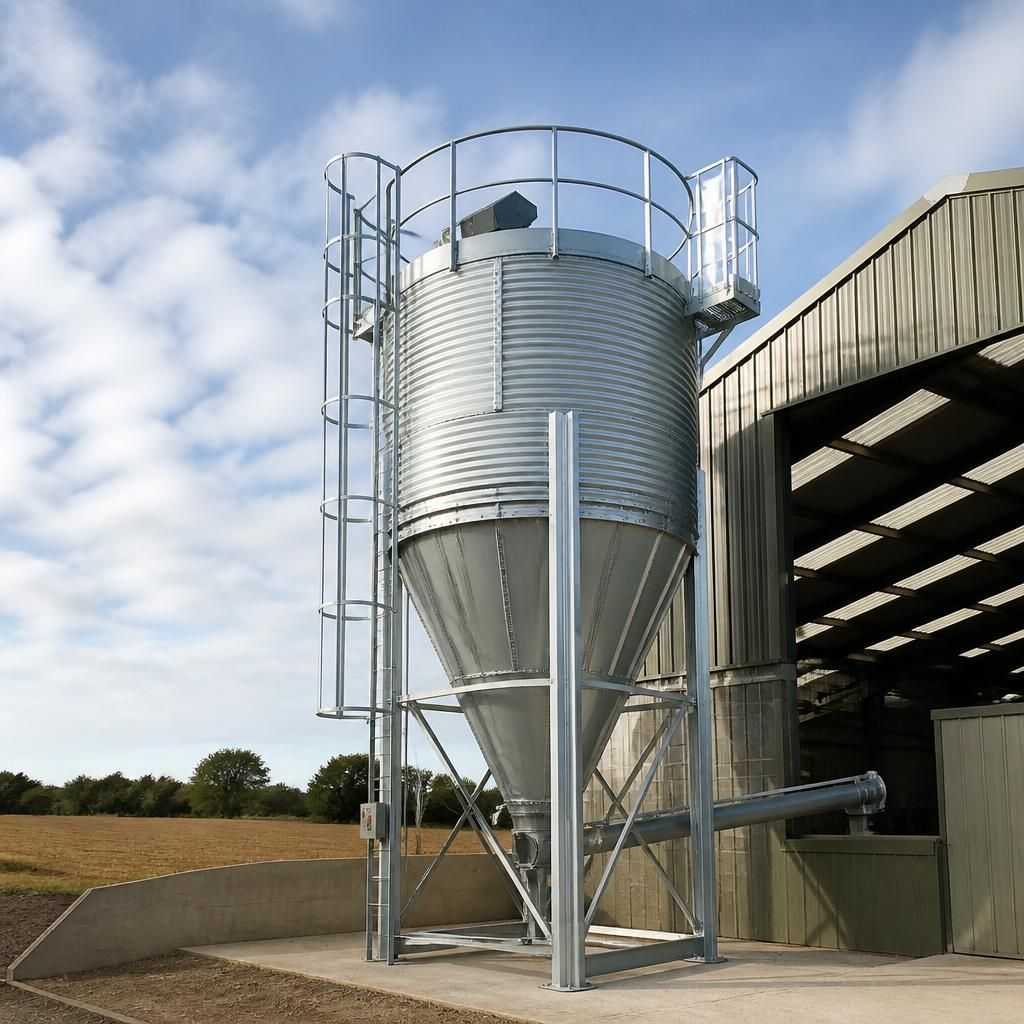
Grain characteristics can determine whether a hopper is suitable, regardless of its nominal capacity. A hopper works best when the stored grain is sufficiently dry, free-flowing and consistent enough to move reliably towards the outlet. Grain containing excess moisture, large amounts of fines or material that compacts readily may bridge above the discharge point or flow unevenly, requiring additional design measures and closer management.
Where these flow characteristics cannot be controlled, a conventional floor store may be more forgiving because grain can be placed, inspected and removed with mobile handling equipment. The choice should therefore consider not only how much grain is stored, but also its condition at intake, expected storage duration and behaviour during discharge.