
How Can Grain Silos Be Integrated with Existing Handling Equipment?
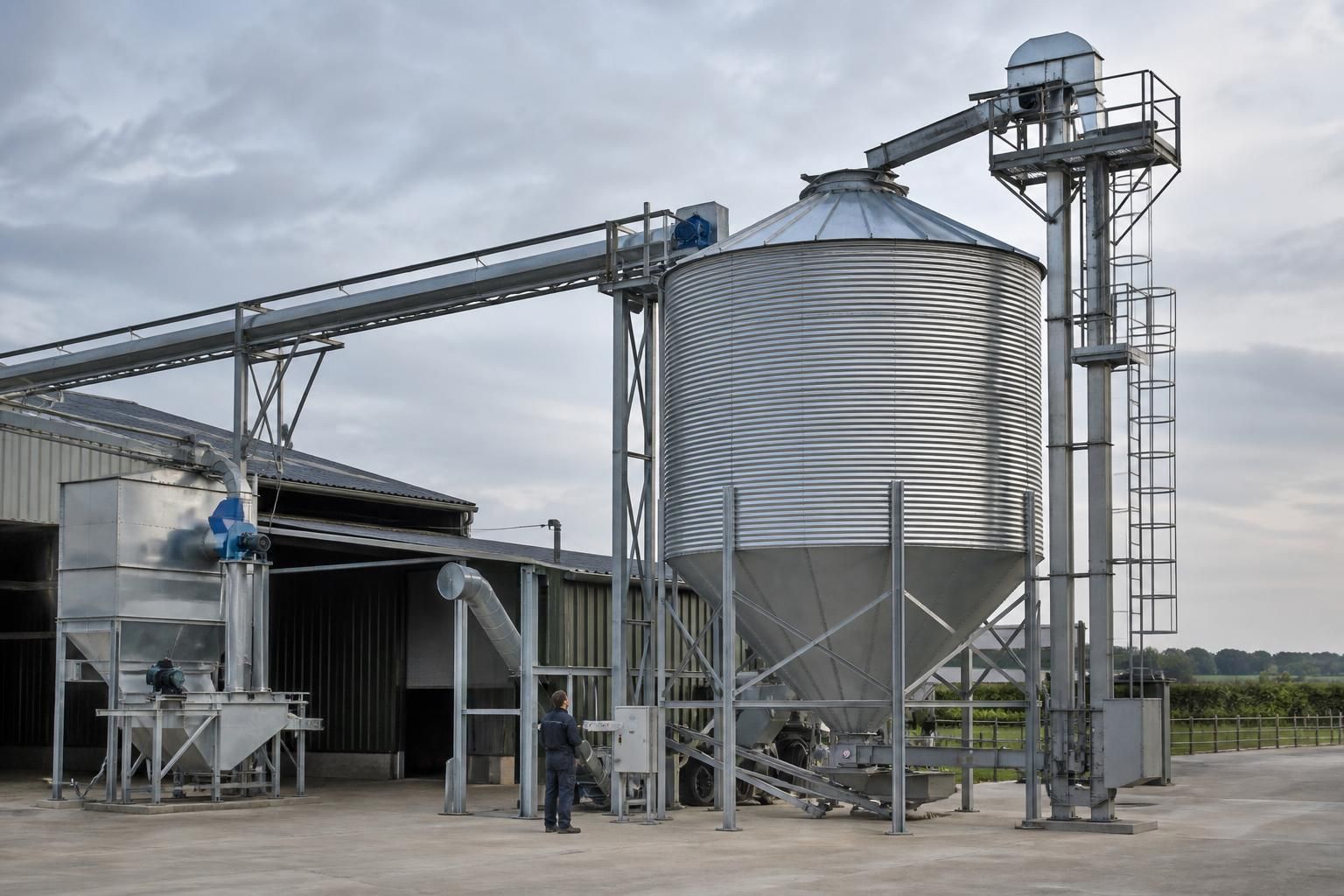
Grain silos can be integrated with existing handling equipment by connecting intake, conveying, cleaning, drying and outloading systems through correctly sized transfer points and compatible controls. The design should account for grain flow, equipment capacity, access for maintenance, structural loading and safe dust management so the silo works as part of the wider handling system.
Grain silos are integrated with existing handling equipment by designing each physical, structural and control interface as part of one coordinated system. The silo position, inlet and outlet arrangements, supporting steelwork, conveying routes, sensors and operating sequence all need to match the equipment already on site rather than being treated as separate installations.
Start with a survey of the existing installation. This should record the location and dimensions of intake points, conveyors, elevators, cleaners, dryers, outloading equipment, access routes and electrical control panels. Available headroom is particularly important where grain must be lifted into a silo, while the position of the discharge outlet determines whether an existing conveyor can receive grain without excessive bends, awkward gradients or additional transfer equipment.
The survey should also identify the condition and capacity of existing supports, slabs and foundations. A silo introduces vertical loads from its own structure and stored grain, as well as wind loads and forces associated with connected equipment. Conveyors, elevators and platforms may require independent supports or additional steelwork so that loads and vibration are not transferred into unsuitable parts of an existing building.
Physical interfaces need to be designed around the movement of grain. Inlet chutes should deliver grain centrally and at a controlled rate, reducing impact, spillage and unnecessary product damage. Outlet arrangements should suit the receiving conveyor or auger, with enough clearance for inspection and cleaning. Where the existing route changes direction, the design should consider how to avoid ledges and pockets in which grain can collect, since retained material can encourage contamination and make product changeovers more difficult.
Different grains and moisture conditions can affect flow behaviour. A system that handles dry, free-flowing material effectively may require revised outlet geometry, agitation or a different conveying arrangement when material is damp or prone to bridging. The integration design should therefore consider the products to be stored, expected throughput, conveying speed and the required level of flow control. Keeping transfer distances short and avoiding unnecessary changes in direction can simplify both operation and maintenance.
Existing equipment must be checked for compatibility rather than assumed to be suitable. The available conveyor capacity, elevator throughput and dryer performance should be compared with the intended filling and emptying rates of the silo. If one component is significantly slower than the others, it can become a bottleneck. Conversely, feeding a conveyor beyond its intended duty can cause blockages, spillage and premature wear. The design may include regulated feeders, variable-speed drives or staged operation where the equipment allows it.
Control integration is equally important. A typical operating sequence may prevent an upstream machine from running until the receiving conveyor is available, then stop the upstream equipment if a downstream fault, blockage or high-level condition is detected. Level sensors can indicate when a silo is approaching capacity, while temperature or moisture monitoring can support storage management where those systems are included. Emergency stops, alarm indications and manual overrides should be positioned and configured so operators can understand the status of the complete handling line.
Control panels and field wiring should be planned alongside the mechanical layout. Cable routes need protection from moving equipment, dust and accidental damage, and instruments should remain accessible for testing or replacement. A clear schedule of motors, sensors, interlocks and alarm conditions helps ensure that the existing controls and the new silo equipment operate as one coherent system.
Dust control and safe access must be incorporated at the connection points. Grain dust is most likely to escape during loading, discharge and transfer, so enclosed chutes, suitable extraction arrangements and effective housekeeping provisions should be considered. The design should also allow safe access to inspection covers, bearings, sensors, valves and cleaning points. Platforms, ladders, guarding and handrails must be positioned without obstructing the movement of grain or routine maintenance activities. A competent designer should assess the applicable machinery, workplace and dust-explosion requirements for the particular installation.
Existing buildings may need local alterations to accommodate the silo connection. These can include openings for chutes, strengthened support steel, revised roof details, access platforms or weatherproof sealing around penetrations. Any alteration should be coordinated with the building’s structural design and checked against other services, including electrical installations, drainage and fire-protection equipment.
Integration is easier to manage when the connection points are documented before fabrication. A coordinated design package can show silo positions, conveyor centre lines, platform levels, access clearances, support reactions and equipment interfaces. Planning elevation drawings help communicate the overall arrangement, while isometric fabrication blueprints provide the dimensional information needed to manufacture connecting steelwork and associated components accurately.
Where future expansion is likely, the layout can reserve space for an additional silo, a second conveying route, spare control capacity or alternative outloading equipment. Planning these provisions at the outset may avoid having to dismantle established routes later. It is still important to distinguish genuine future requirements from unused complexity: every additional transfer, valve and support introduces another item to inspect and maintain.
Commissioning should take place in stages. First, the mechanical connections, guards, access provisions and structural fixings can be inspected. Controls and interlocks should then be tested without grain, followed by a controlled test using the intended product. Operators should check filling levels, discharge behaviour, transfer points, alarms, emergency stops and clean-down arrangements. Any changes made during testing should be recorded in the final drawings and operating information so that the completed installation remains clear to those responsible for running and maintaining it.
For a bespoke steel-framed project, these integration requirements can be developed alongside the building design rather than added after manufacture. Buildings UK Ltd provides design information including planning elevation drawings and isometric fabrication blueprints, allowing the relationship between the silo area, supporting steelwork and existing handling equipment to be considered before fabrication. The result should be a maintainable arrangement in which storage capacity, grain flow, structural support and control logic work together.
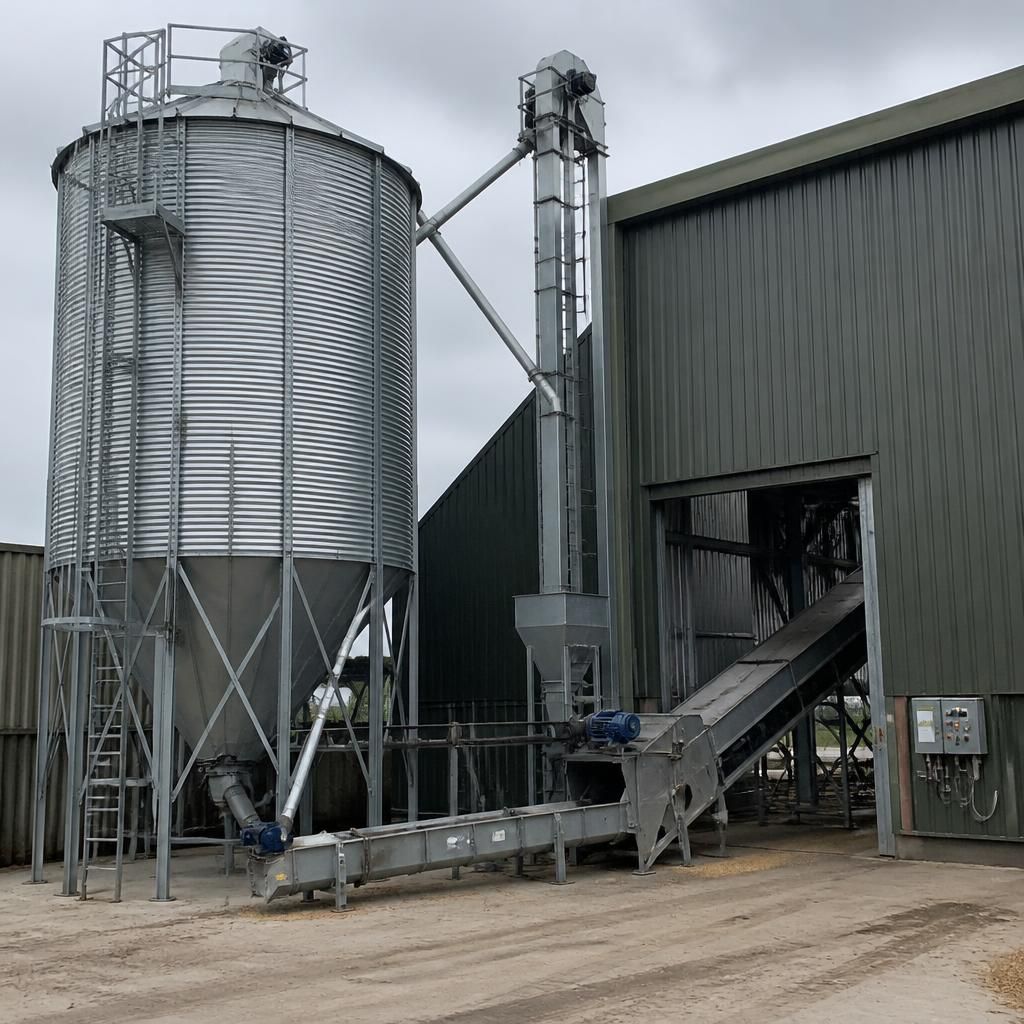
The silo base and discharge method should be selected to suit the equipment receiving the grain. A hopper-bottom silo can feed a conveyor or auger from a defined outlet, while a flat-bottom silo may require sweeping equipment to collect the remaining grain before it reaches the discharge route. The choice affects outlet height, support steelwork, access requirements and the position of the receiving conveyor.
Discharge capacity must also be compatible with the downstream system. A controlled gate or feeder can regulate the flow where the conveyor, cleaner or loading equipment cannot accept the silo’s full discharge rate. This helps prevent surging at transfer points and gives operators greater control when changing between storage cells or directing grain to different parts of the handling line. The arrangement should leave sufficient clearance for inspection, cleaning and removal of wear components without dismantling the wider system.
Discuss Integrating Your Grain Silo with Existing Equipment
If you are assessing how a new grain silo could connect with your existing handling line, discuss your site layout, equipment interfaces and future requirements with Buildings UK Ltd. This provides a practical basis for developing the appropriate bespoke design information for your project.