
How should moisture be controlled in grain stores?
Moisture in grain stores should be controlled by harvesting grain at a suitable moisture level, using appropriate drying and aeration, and monitoring conditions throughout storage. Good airflow, sealed building elements and regular checks for condensation, leaks and localised heating help maintain grain quality and reduce spoilage.
Moisture control in a grain store is the management of grain water content, air humidity, temperature and building conditions so that moisture does not migrate, condense or create localised spoilage. Effective control depends on combining suitable building design with correct loading, drying, air distribution, monitoring and maintenance.
Control moisture before storage. Grain should be assessed as it enters the store rather than relying on an average moisture reading for the whole load. Moisture can vary between fields, trailers, loads and areas within a single batch. Sampling should therefore be representative, with separate attention given to grain that has been harvested in damp conditions or contains green material, fines or foreign matter. The target moisture level depends on the crop, intended storage period, temperature and storage system.
Drying should remove moisture evenly without damaging the grain. Excessive drying can reduce quality and increase energy use, while insufficient drying leaves wetter pockets that may deteriorate first. Where batches have different moisture levels, they should not be mixed indiscriminately. A clear record of crop type, source, moisture readings, drying treatment and store location helps identify higher-risk areas during later inspections.
Understand moisture migration. Grain can create air movement within a bulk through temperature differences. Warmer grain heats the air around it, causing that air to rise; cooler areas can then draw air downwards. As the air moves, moisture may be redistributed and concentrated in particular zones. This is why a bulk can contain a local wet area even when an overall sample appears acceptable.
Temperature changes between day and night, or between the grain and the external air, also affect condensation risk. Condensation is most likely where humid air meets a surface that is below its dew point, including cold roofs, uninsulated cladding, structural members and areas around openings. Insulation, correctly detailed vapour control layers and the elimination of water ingress reduce the risk, but they do not compensate for grain that has been stored too wet.
Design the building to prevent water entry. The roof, gutters, flashings, doors, vents and wall junctions should be detailed so that rainwater is directed away from the grain and cannot track into the store. Floors should be suitable for the intended loading and arranged so that surface water cannot collect beneath or around the stored crop. Any drainage channels, thresholds or service penetrations need to be kept clear and checked for points where water could enter.
Internal surfaces should be easy to inspect and clean. Gaps, damaged sealants and poorly fitted panels can allow humid air or rainwater into the building, while dust accumulation can obstruct vents and conceal early signs of dampness. A clean, well-maintained envelope makes it easier to distinguish a storage problem from a building defect.
Use airflow selectively. Ventilation should be based on the condition of the grain and the outside air, not simply on running fans continuously. Introducing air that is cooler or drier than the grain can help remove heat and moisture; introducing warm, humid air can increase the moisture burden. Air should be distributed through the full depth of the bulk, with ducting, slots or channels sized and positioned to avoid stagnant zones.
Airflow paths should not be blocked by excessive fill heights, compacted fines or uneven loading. Grain should be levelled where appropriate, and fines should be managed because they can restrict air movement and form dense pockets. In stores using floors or ducts for aeration, access for cleaning and inspection is important because accumulated dust and debris can reduce performance and create uneven distribution.
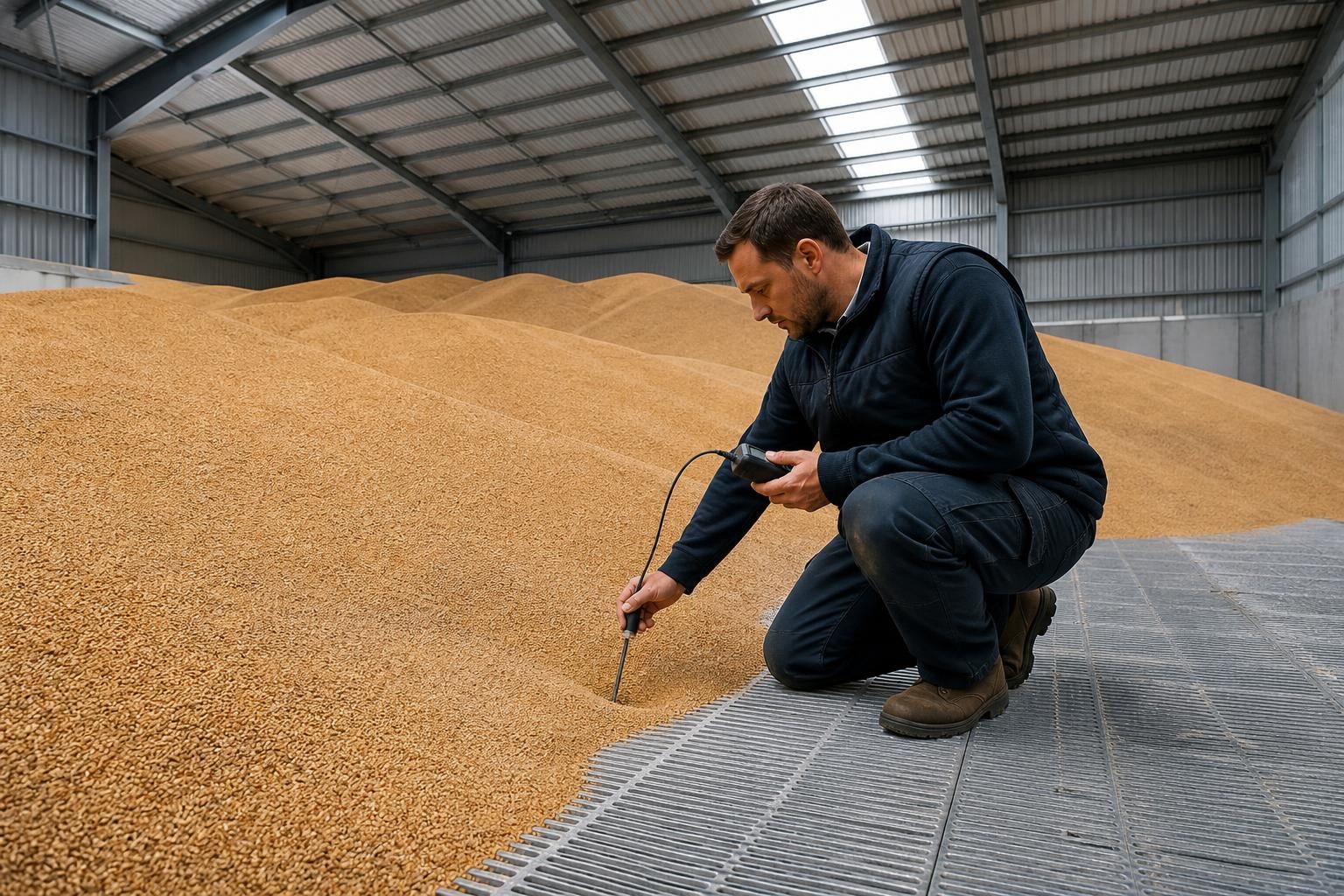
Monitor the bulk, not just the room. Temperature and moisture checks should cover several points and depths, including the top surface, edges, corners, near walls, around ducts and areas beneath the roof. These locations are more likely to show temperature gradients, restricted airflow or condensation than a single central reading. Fixed sensors can provide continuous information, while manual checks help verify unusual readings and inspect the physical condition of the grain.
Readings are most useful when compared over time. A rising temperature in one area, a change in humidity, a developing crust or a difference between the centre and edges can indicate moisture movement or biological activity before widespread damage is visible. Records should note the date, location, crop, weather conditions and any ventilation or drying activity, allowing trends to be distinguished from isolated readings.
Manage loading and unloading carefully. Grain should be placed into the store in a way that limits segregation and avoids creating piles of fines in one area. Different qualities or moisture levels should be kept identifiable rather than combined without assessment. During unloading, caked grain, unusual odours, discoloured material and warmer pockets should be treated as warning signs requiring investigation. Disturbing a suspect area without considering dust and worker safety can spread the problem or create additional hazards.
Routine inspections should include the roof underside, wall surfaces, floor edges, doors, seals, vents, fans, ducts and sensor equipment. Any water ingress or damaged insulation should be corrected before the next crop is stored. Spilled grain and dust should be removed because they can retain moisture, obstruct airflow and support deterioration around the main bulk.
For a new or adapted grain store, moisture performance should be considered at the design stage. The building layout, structural clearances, insulation, ventilation arrangement, aeration equipment, access for sampling and drainage all affect how reliably conditions can be controlled. A properly documented design should show how air reaches the stored grain, how moisture-laden air leaves the building and how key components can be maintained without compromising the store’s integrity.
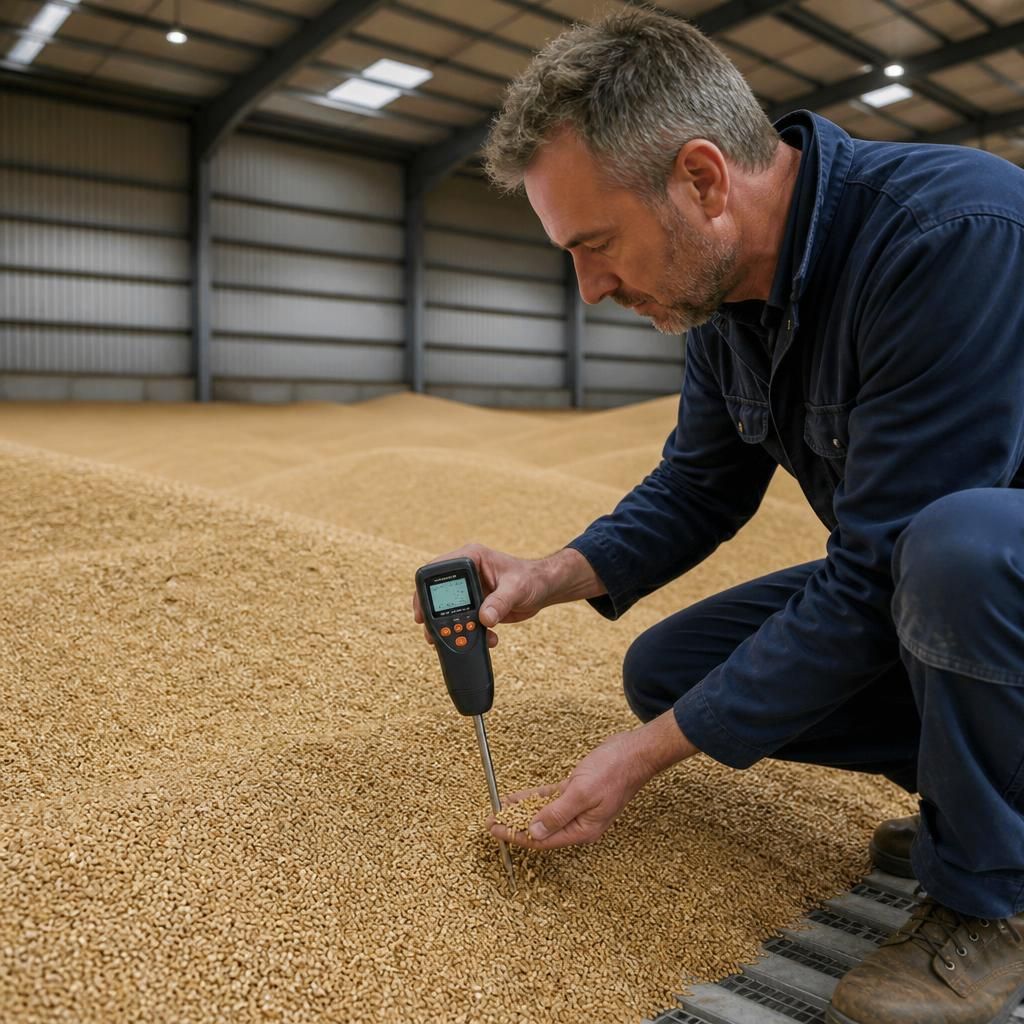
Reliable moisture measurement is essential because drying and aeration decisions are only as accurate as the readings on which they are based. A grain moisture meter should be suitable for the crop being tested, kept clean and checked against the manufacturer’s instructions. Readings can be affected by grain temperature, sample preparation, fines and uneven moisture distribution.
Take several samples from different loads and locations rather than relying on one handful. Mix or prepare each sample consistently, remove obvious foreign material where appropriate, and allow for temperature differences when using the meter’s compensation function. If a result appears unusual, repeat the test with a fresh sample and compare it with a second method or a properly checked instrument.
Record the reading alongside the crop, sample location and date. A sequence of comparable measurements is more useful than an isolated figure, particularly when deciding whether a batch needs further drying or can be moved into longer-term storage. Any meter that produces unexplained changes should be cleaned, checked and recalibrated before the result is used to manage the bulk.