
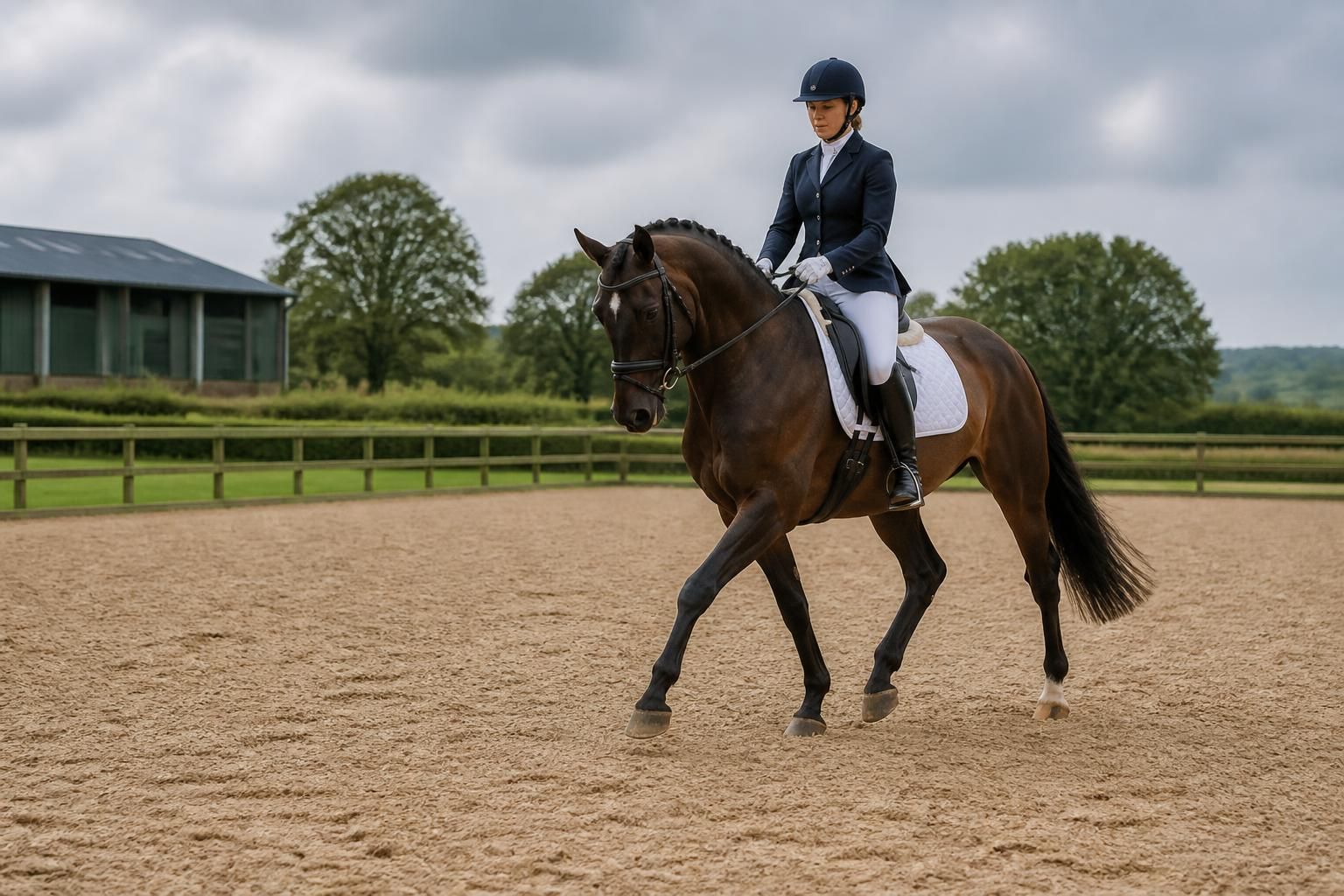
Which dressage arena surface is suitable for your riding programme?
The most suitable dressage arena surface depends on your riding programme, desired firmness and grip, and how consistently the arena must perform in changing weather. A correctly specified sand-based surface, with or without stabilising fibre or cushioning additives, should be selected alongside the arena’s drainage design and planned maintenance routine.
The right dressage arena surface is the one that provides predictable hoof support for the work being performed, without becoming excessively deep, hard or loose. A surface for basic schooling may prioritise consistent movement and practical upkeep, while a competition-focused arena usually requires a more controlled feel, even tracking and reliable performance across the whole working area.
Start with the type and intensity of work. Consider the movements regularly ridden, the horses using the arena and whether the surface will support one rider at a time or repeated daily use. Walk, trot and canter schooling place different demands on the footing from collected work, lateral movements, extensions, transitions and frequent circles. A surface that feels comfortable for general exercise may not provide the same level of stability when the horse is asked to engage the hindquarters or change direction precisely.
- General schooling: A well-graded sand surface can be appropriate where the programme involves routine flatwork and the priority is a consistent, manageable footing.
- Progressive dressage training: A sand surface incorporating stabilising fibre may be considered where the arena must retain more structure during repeated movements and higher levels of work.
- Competition preparation: The surface should reproduce the feel expected at the venues where the horse will compete as closely as practical. Consistency, controlled movement and a uniform response under the hoof become particularly important.
- Young or inexperienced horses: A forgiving surface with sufficient support can help avoid an unnecessarily demanding feel while the horse develops balance, strength and coordination.
- Rehabilitation or carefully managed exercise: The footing should be selected with input from the horse’s veterinary or rehabilitation team. Surface choice alone cannot compensate for an unsuitable workload or an underlying condition.
Firmness and penetration need to be balanced. If the top layer is too firm, it may offer limited hoof penetration and can feel unforgiving during movement. If it is too loose or deep, the horse may use more effort to move through it, lose confidence in turns or struggle to maintain regularity. Excessive movement beneath the hoof can also make transitions and lateral work less precise. The suitable level of firmness depends on the horse, the discipline demands and the way the arena is constructed, rather than on a surface label alone.
Grip should support movement without stopping it. Dressage horses need enough traction to push off, turn and carry weight without the hoof sliding unpredictably. At the same time, an excessively gripping surface may restrict natural movement and increase strain during rotation. Fibre, sand grading, moisture content and the condition of the base all influence how the surface behaves. These elements should be assessed as a complete specification rather than selected independently.
Choose the surface construction according to the desired behaviour. Sand-only systems are comparatively straightforward, but their performance depends heavily on the sand’s grading, depth and condition. Fibre-reinforced systems can add cohesion and alter the way the surface holds together under traffic. They may suit a programme requiring a more stable, structured feel, but they also require the correct installation and ongoing management. Cushioning materials may change impact absorption and comfort, although more cushioning is not automatically better for every horse or every form of dressage work.
When comparing samples or existing arenas, assess more than the initial impression underfoot. Check whether the surface remains even along the track, across the centre line and in areas where circles are frequently ridden. Look for inconsistent depth, displaced material, compacted patches, loose corners and changes in feel after wet or dry weather. A surface that performs well in one area but not another is unlikely to support accurate schooling.
The arena base and surface layers must also be compatible with the programme. A carefully selected top dressing cannot correct a base that is uneven, poorly consolidated or unable to deal with water. Similarly, the correct surface depth and profile depend on the construction beneath it. This is why specification should consider the arena as a layered system, including the base, separation layers where required and the finished riding surface.
For most dressage programmes, the decision can be narrowed by answering four practical questions:
- What movements and levels of work will be performed most often?
- Does the horse need a more forgiving feel, or does the rider require greater stability for advanced schooling?
- Will the arena be used by a single horse occasionally or by several horses throughout the week?
- Can the chosen surface be maintained in a condition that remains consistent with the programme?
Buildings UK can incorporate the intended use into the design of a bespoke equestrian building package, allowing the arena specification to be considered alongside the overall structure and site requirements. The final choice should be based on the expected riding programme, the horses’ needs and the performance that can be maintained in practice, rather than selecting the most complex or most cushioned option by default.
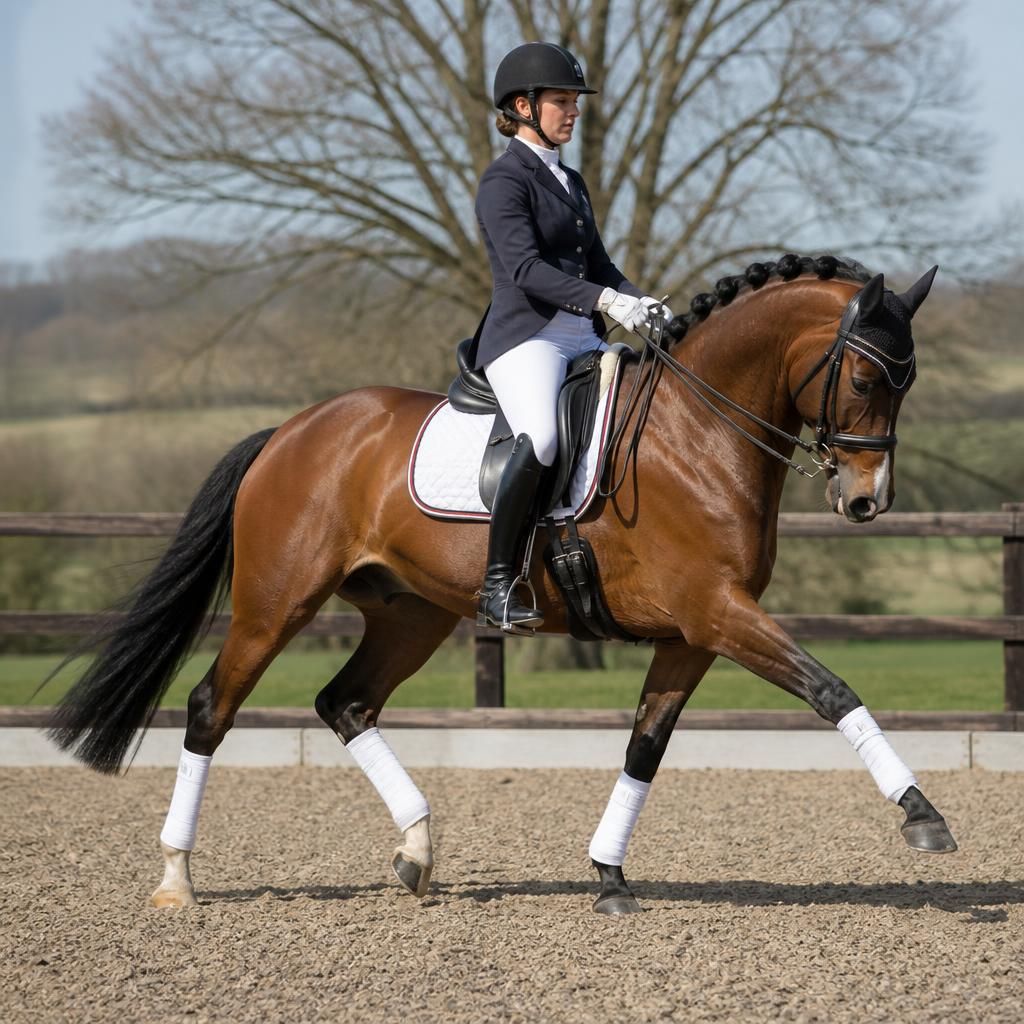
Whether the arena is indoor or outdoor should form part of the surface decision. A roofed arena does not receive the same rainfall, evaporation or natural weathering as an outdoor arena, so its surface may require a different approach to moisture management. Ventilation, exposure to wind and the method used to add or retain moisture can all influence how the footing feels during a riding session.
For an indoor dressage arena, assess the proposed surface in relation to the building design rather than treating the footing as a separate purchase. The specification should account for the enclosed environment, the planned riding frequency and how the surface will be conditioned. For an outdoor arena, consider how the surface will respond to changing weather and site exposure. Buildings UK can consider the intended riding environment within a bespoke equestrian building package, helping the arena structure and riding surface to be planned as compatible parts of the same project.