
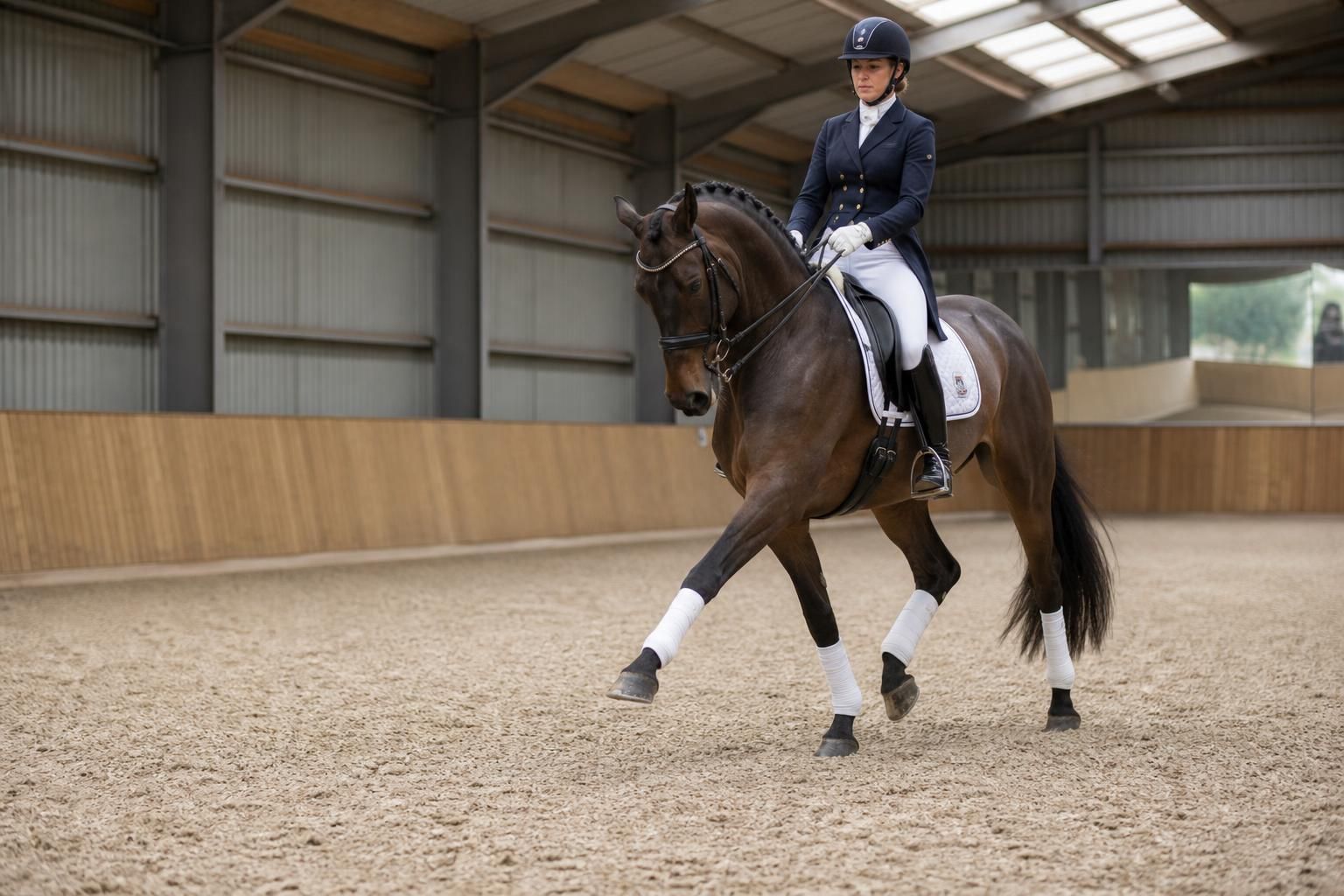
Which surface characteristics support accurate dressage movements?
Accurate dressage movements depend on a surface that is level, consistent and predictable, with enough cushioning to support comfort and sufficient firmness for balance and impulsion. Reliable hoof grip, controlled moisture retention and uniform footing help the horse maintain rhythm, straightness and confidence through transitions, lateral work and precise lines.
Accurate dressage movements are supported by footing that deforms in a controlled way beneath the hoof, then provides a stable platform for push-off and landing. The important characteristics are not limited to the material used; particle grading, shape, cohesion, compaction and the way the surface interacts with its base all affect how confidently a horse can perform precise work.
Controlled hoof penetration is essential. A hoof should engage with the surface enough to dissipate impact and create traction, without sinking so deeply that the horse has to lift its limbs through excessive resistance. Excessive penetration can make transitions feel laboured and may reduce the horse’s ability to step underneath its body. Very shallow penetration, by contrast, can make landings feel abrupt and reduce comfort.
The surface also needs appropriate shear resistance. This describes how well the footing withstands the sideways and rotational forces produced during movements such as shoulder-in, travers, half-pass and pirouette work. If the particles displace too readily, the hoof may slide during the loading phase. If they lock together excessively, the hoof may not release naturally during the next step. A suitable surface allows the hoof to load, push and lift without an abrupt change in resistance.
Particle characteristics influence this behaviour. A well-graded blend can reduce large voids between particles and help the footing knit together, while particle shape affects both stability and movement through the layer. Rounded particles may move more freely; angular particles can interlock more strongly. The appropriate balance depends on the arena design, the underlying construction and the work expected from the surface.
Elastic response and energy return matter particularly in collected work and transitions. When the horse lands or loads a limb, the surface should absorb part of the impact without feeling dead or excessively soft. It should then allow the hoof to leave without a delayed or springy reaction. An inconsistent response from one stride to the next can interrupt rhythm, alter the horse’s balance and make movements less precise.
For accurate lines and changes of direction, the footing should also resist rutting, displacement and local compaction. Small depressions or loose patches can alter the height and timing of individual steps, which is especially noticeable in extended lines, square halts and lateral movements. This is why the surface should be assessed after representative schooling rather than judged only when freshly prepared.
- Support beneath the loading limb: the hoof should meet a stable layer that does not collapse suddenly under bodyweight.
- Controlled lateral resistance: the horse should be able to turn and move sideways without unwanted slipping or sticking.
- Manageable rebound: the surface should not return impact energy so sharply that it disrupts the horse’s balance.
- Stable particle distribution: the footing should remain integrated during normal use rather than separating into loose and compacted areas.
- Low variation through the working layer: the same movement should receive a similar mechanical response across the arena.
These characteristics should be considered alongside the horse’s way of going, the level of training and the type of movements regularly practised. A surface that feels supportive for basic schooling may respond differently under collected work, repeated transitions or frequent rotational movements. Trialling the arena at walk, trot and canter, including halts, transitions and lateral exercises, gives a more useful indication than evaluating the loose material alone.
Specification should therefore consider the complete surface profile: the selected footing, its depth and compaction, the stability of the layer beneath it and how the surface is maintained. Professional design information and fabrication drawings can define the arena structure, but the final riding assessment should confirm that the finished surface produces the required response for accurate dressage work.
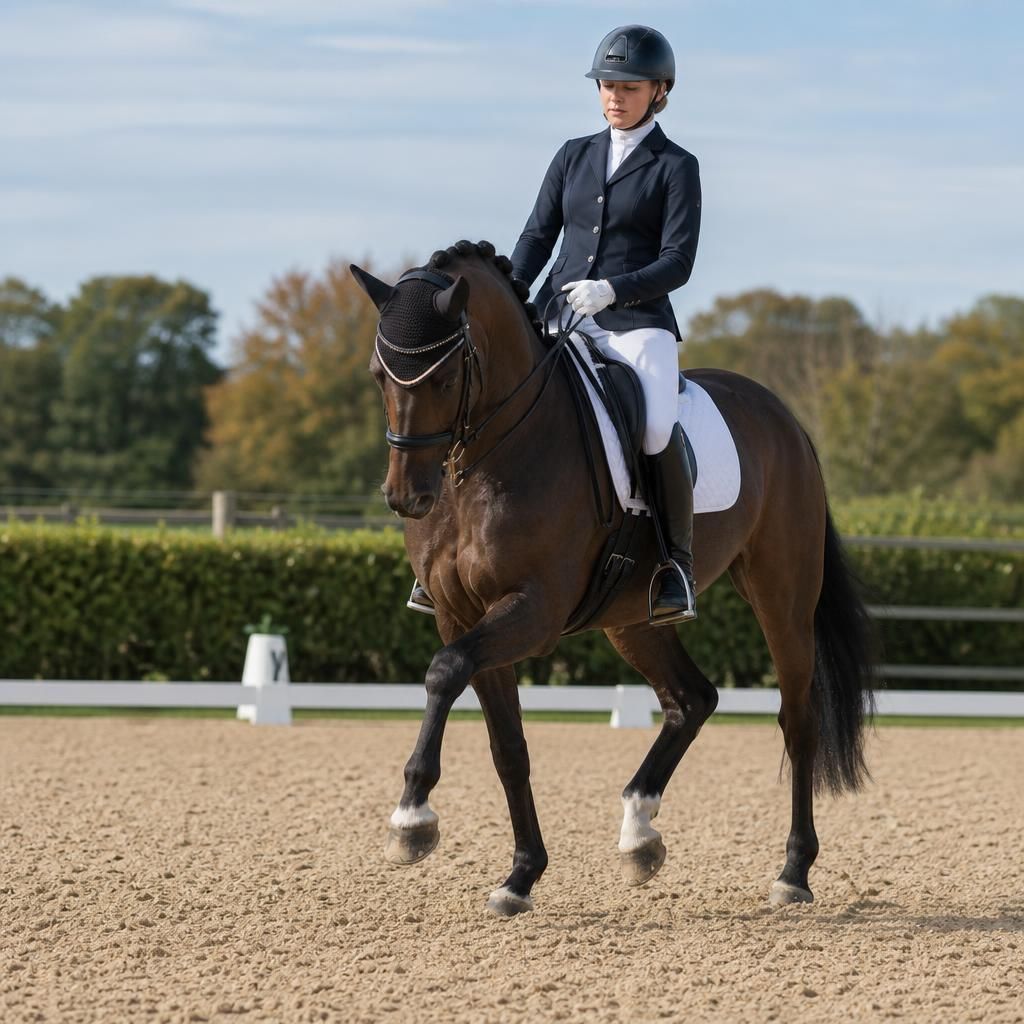
Surface cleanliness is a practical characteristic of a dressage arena because isolated debris can affect hoof placement and confidence. Stones, compacted clumps, roots or other foreign material may create localised discomfort or cause the horse to alter a step during precise work.
The working layer should therefore remain free from obvious contaminants and unwanted accumulations, particularly along the track, at corners and near the arena entrances. Checking the surface on foot before riding can identify material that has migrated from the edges or become concentrated in particular areas. Keeping the footing separate from surrounding soil, gravel and organic matter helps preserve the consistent feel required for accurate movements.