
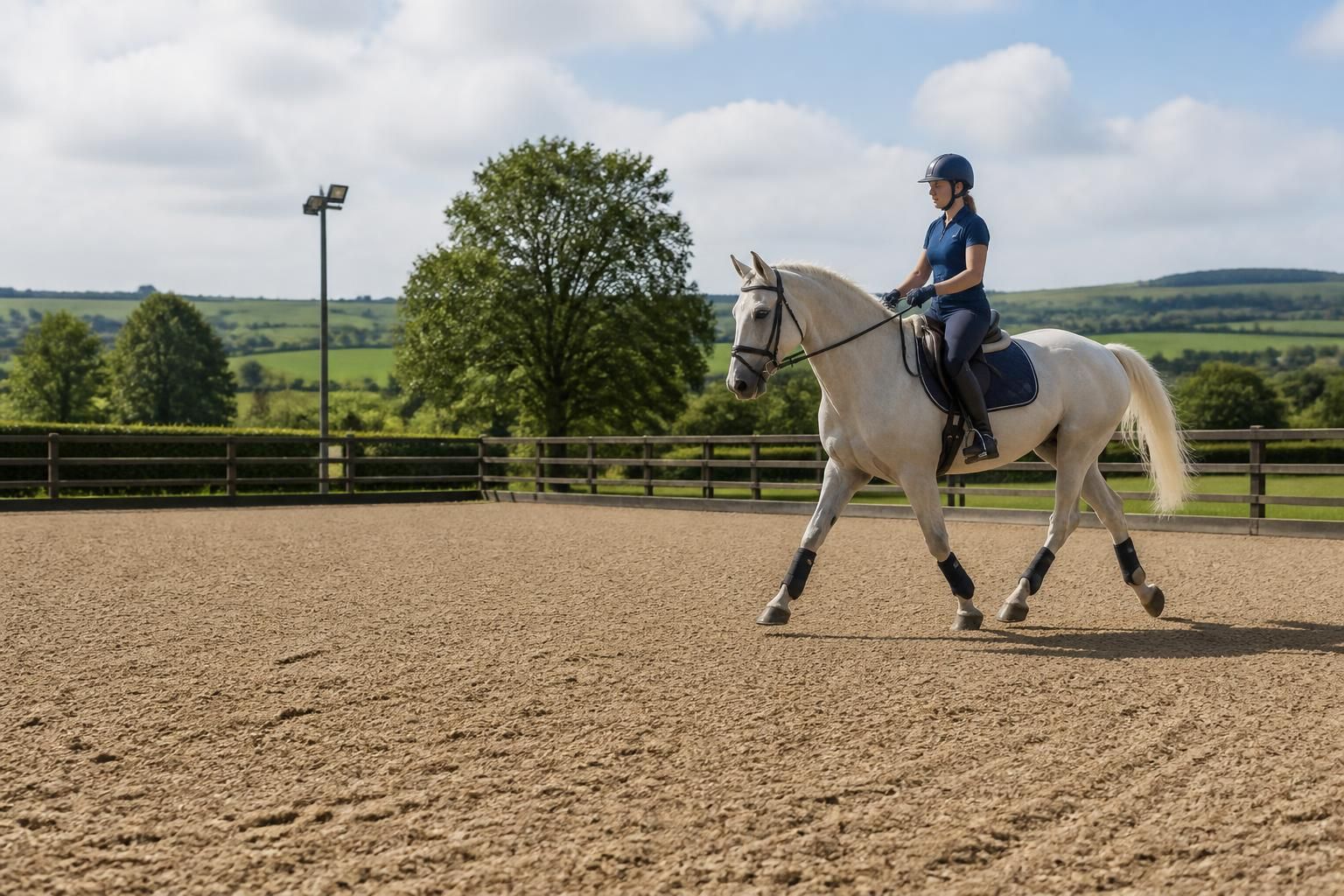
How should a horse riding arena surface be specified?
A horse riding arena surface should be specified as a complete system, matching the intended use, local ground conditions and maintenance regime. Define the formation and drainage, suitable sub-base, surface material, depth and edge restraint so the finished arena provides consistent footing, manages water effectively and remains practical to maintain.
A horse riding arena surface should be specified by its required performance rather than by a material name alone. The specification should state how the riding layer is expected to behave under hoof traffic, how it will interact with the supporting construction, and how its condition will be assessed and maintained.
Start with the riding discipline and level of use. A surface for dressage may need a particularly even, stable feel for precise movements, while a jumping arena must tolerate concentrated landings and repeated traffic around take-off and landing areas. General schooling, private use, lungeing and commercial use can each place different demands on the surface. The specification should also consider the number of horses using the arena, likely frequency of use and whether it must remain serviceable through periods of wet or dry weather.
Define the properties of the riding layer. The surface material should be described in terms of particle size, grading, shape, cleanliness, moisture behaviour and resistance to displacement. Sand that contains excessive fines can bind, become dusty or hold water poorly, whereas material that is too uniformly coarse may lack cohesion. Particle shape also affects movement: rounded particles can roll under hoof, while appropriately graded angular particles can interlock more effectively. The chosen material should be free from contaminants, organic matter and sharp inclusions that could present a risk to horses.
Where fibre, rubber or another stabilising additive is proposed, specify its purpose and proportion as part of the system rather than treating it as an optional extra. Additives can alter shock absorption, traction, moisture retention and maintenance requirements. The specification should identify how the additive is distributed through the riding layer and whether it is compatible with the selected sand and expected method of maintenance.
Separate the surface specification from the construction specification. The riding layer is only one part of the arena. The supporting layers influence stability, water movement and the way the surface responds to hooves and machinery. The written specification should identify the required material quality, compaction standard, finished levels and tolerances for each layer. It should also record any separation or reinforcement layer required where the site investigation indicates a risk of materials mixing or the formation losing stability.
Site conditions should be reflected in the specification. Existing soil, groundwater, seasonal wetness, slope, contamination and the intended position of the arena can all affect the appropriate build-up. A surface that performs well on a free-draining site may require a different supporting arrangement on heavy clay or made ground. The specification should therefore be based on site information rather than copied from an unrelated arena.
Specify water management in practical terms. The arena should be designed so that water can leave the riding surface without washing out the material or creating soft spots. The specification should set out the relationship between the finished arena levels, the perimeter detail and any drainage components. It should also address the outfall or discharge route, because a drainage arrangement is incomplete if collected water has nowhere lawful and suitable to go.
Include edge and transition details. The perimeter should prevent the riding layer from spreading into surrounding ground while avoiding a hazardous abrupt change for horses. Kerbs, boards or other restraints need to be suitable for the arena construction and positioned so they do not create exposed sharp edges. Entrances should be considered separately, as gates and access routes are common locations for surface loss, rutting and contamination from wheels.
Set installation and acceptance requirements. A useful specification should require:
- confirmation that the formation and supporting layers are at the correct levels before the riding material is placed;
- controlled delivery, spreading and mixing of the surface material to avoid segregation;
- checks on finished level, evenness and depth across the arena;
- inspection of edges, entrances and any drainage interfaces;
- removal of unsuitable or contaminated material before completion; and
- completion records identifying the materials used and the maintenance guidance provided.
Testing and inspection should match the risks of the project. Visual inspection alone may not identify variations in depth, weak areas or poor separation between layers. Level checks, depth checks and assessment after initial use can help identify whether the installed surface matches the written specification. Any acceptance criteria should be agreed before construction begins, rather than introduced after defects appear.
Specify maintenance alongside the material. The required harrowing or levelling method, watering approach, frequency of grooming and arrangements for removing droppings should be recorded. The specification should state which machinery is suitable, how deeply it may work and where material may need topping up. Maintenance must preserve the intended profile without disturbing the supporting layers. It should also include periodic checks for compacted areas, unevenness, displaced material, contamination and changes in water behaviour.
For a procurement or design brief, the clearest format is a written schedule covering intended use, performance requirements, material characteristics, supporting construction, edge details, installation checks, maintenance and handover information. This gives the designer and contractor a common basis for comparing proposals and helps ensure that the finished arena is judged by how the complete surface performs, not simply by the name or apparent quantity of the top material.
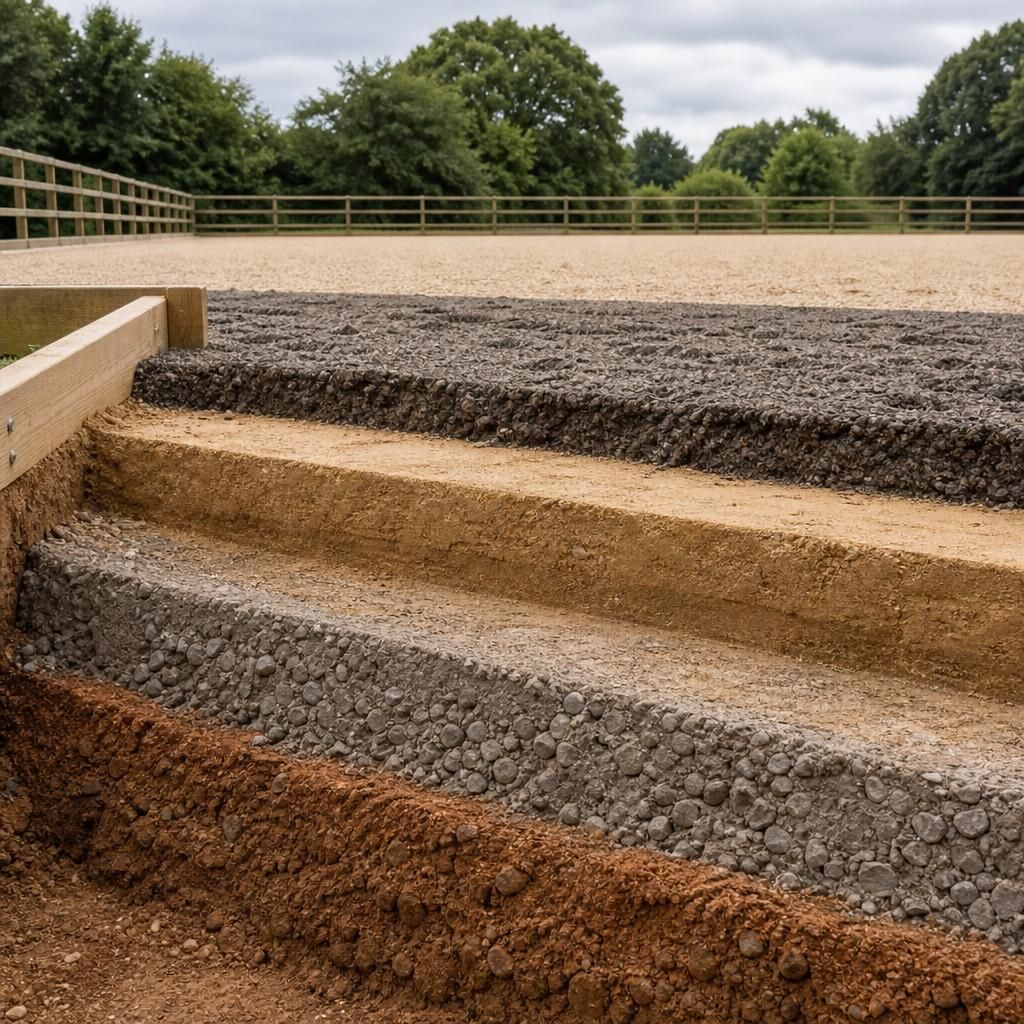
A practical horse riding arena surface specification should include a trial section where the proposed materials and installation method can be assessed before the full riding layer is placed. This allows the designer and contractor to check the surface’s feel, stability, moisture response and interaction with the planned maintenance equipment under representative conditions.
The trial should use the same supporting layers, surface material, additives and installation process intended for the arena. Record the approved material blend, loose depth, finish and method of preparation so the agreed result can be reproduced consistently across the remaining area. If the trial exposes excessive movement, poor drainage or unsuitable maintenance behaviour, the specification can be adjusted before the main installation is completed.