What happens during the manufacture of an industrial steel building?
Industrial steel building manufacture typically moves from approved bespoke design and fabrication drawings to precision cutting, drilling, welding and finishing of the hot rolled steel frame. Each component is checked against the design before the building is prepared as a kit for delivery or assembled through an erection service.
Industrial steel building manufacture is a controlled process in which an approved structural design is converted into accurately identified, finished steel components ready for site assembly. For a bespoke hot rolled steel building, the factory work must produce a complete set of frame members, connection components and associated steelwork that corresponds with the agreed drawings.
Design information is released for fabrication
Before manufacturing begins, the design package is used to establish the exact requirements for each steel component. This includes the length and section of the main frame members, the position of connection plates, the size and location of bolt holes, base connections, bracing and any secondary steelwork. Isometric fabrication drawings provide the production reference, showing how individual parts relate to the completed structure.
Each component can then be given an identification reference. Clear identification is important because a steel building contains many similar-looking members that may have different positions or connection details. The references allow components to be matched with the fabrication drawings and later arranged logically for delivery and erection.
Steel is prepared for accurate fabrication
Hot rolled steel sections are selected and prepared in accordance with the approved specification. Fabricators set out the required cut lengths, connection positions and fabrication details so that the finished members fit together as designed. End cuts, notches and connection plates must be produced accurately; small errors at this stage can affect the alignment of the frame during assembly.
Connection components are prepared alongside the main members. These may include base plates, cleats, brackets, splice plates and other fabricated details. Holes are positioned to suit the specified bolts and the adjoining steelwork, while welded attachments are placed according to the fabrication drawings.
Members and connections are assembled
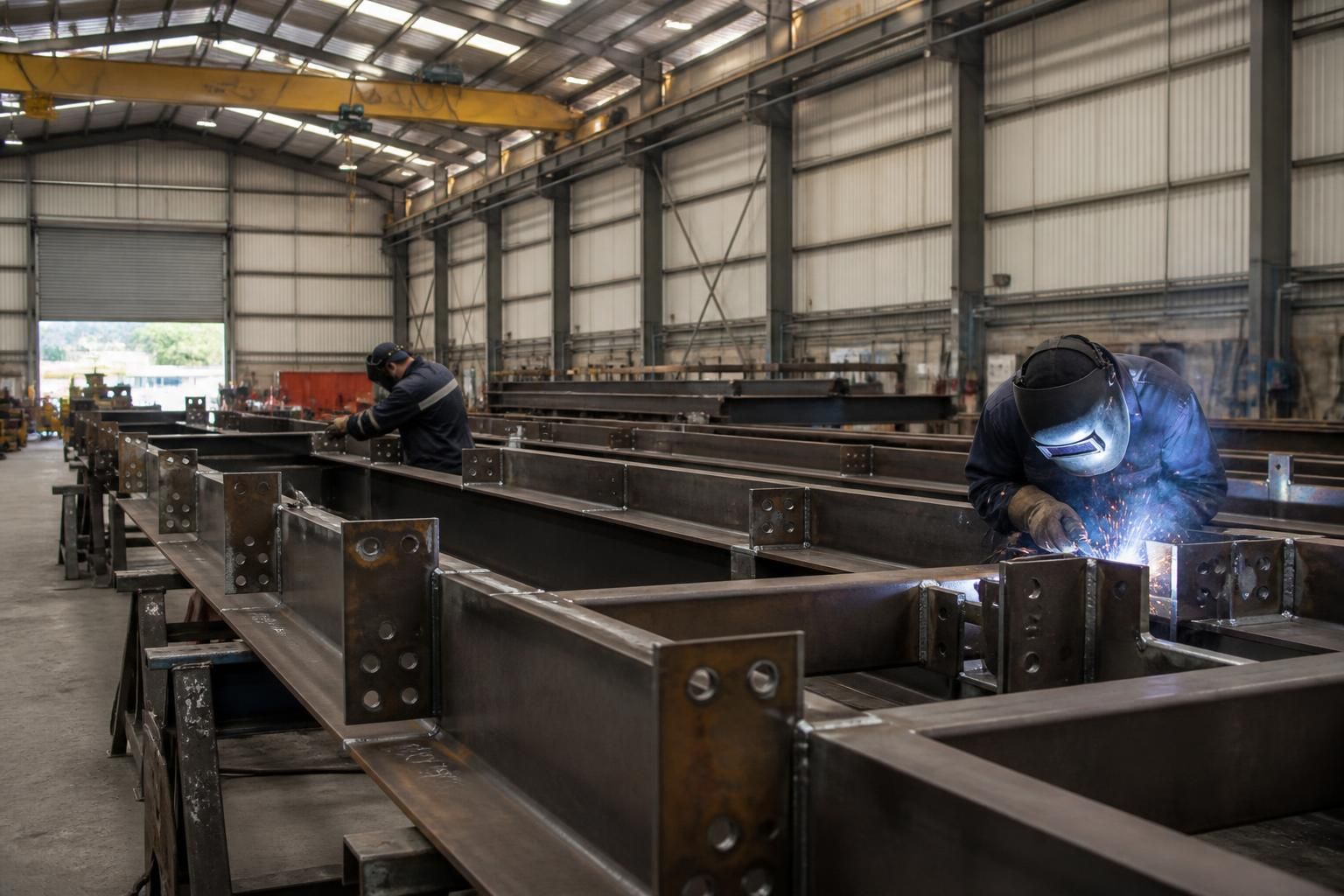
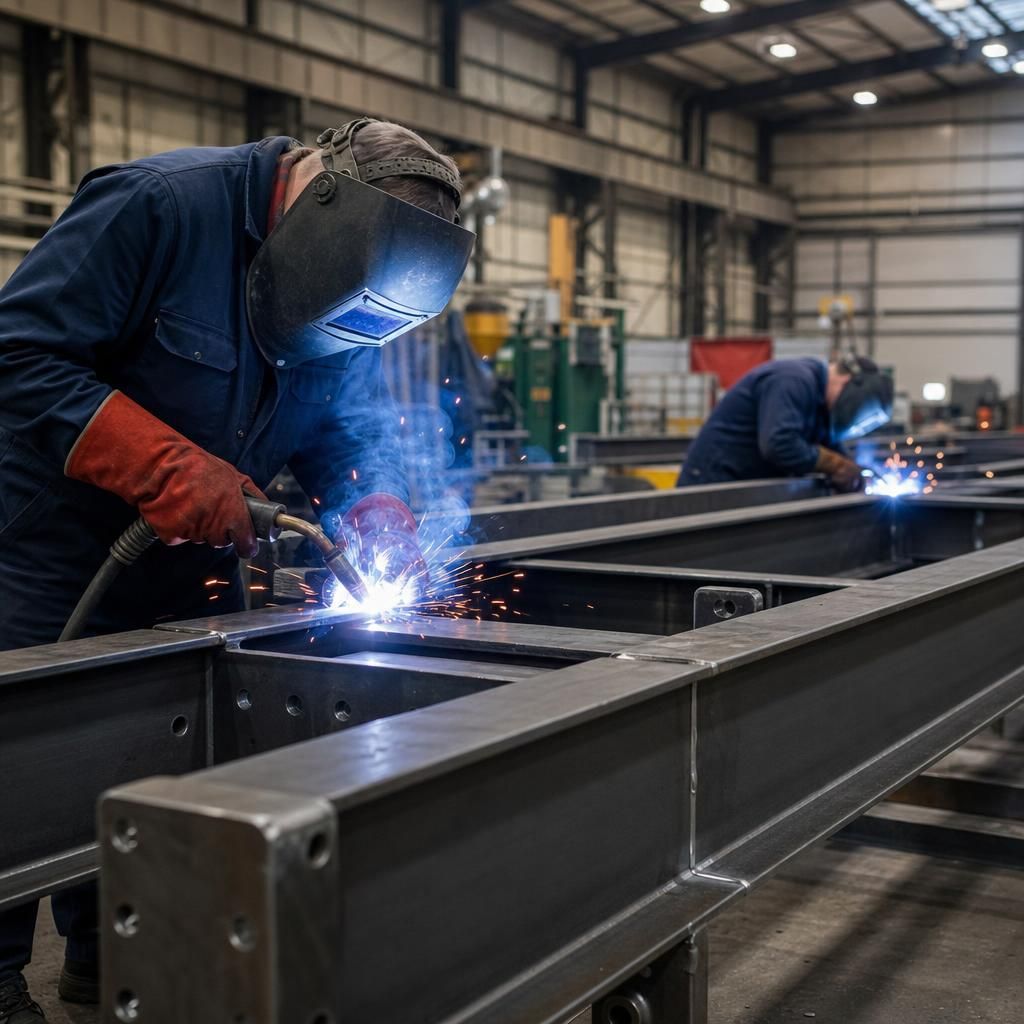
Where a component includes more than one piece of steel, the parts are positioned and held in the correct relationship before being permanently joined. Welded connections are formed by suitably controlled fabrication procedures, with attention given to joint preparation, alignment and the finished weld profile. The aim is not simply to produce a visually neat weld, but to create a connection that corresponds with the structural design.
Long or complex members may require careful handling and temporary support while they are being fabricated. Maintaining the intended straightness and geometry helps the frame assemble correctly and prevents avoidable adjustment work on site.
Quality checks take place throughout the process
Inspection is not limited to the finished frame. Checks are made during fabrication to confirm that members have the correct identity, dimensions and connection details. Typical checks include:
- comparing the component with its fabrication drawing;
- checking cut lengths, member orientation and overall dimensions;
- confirming the position and size of holes, plates and brackets;
- examining welded areas for visible defects and incomplete or inconsistent work;
- checking that the finished member is suitably aligned and ready for assembly.
Any discrepancy needs to be resolved before the component is incorporated into the completed building package. This drawing-led checking process is particularly important for bespoke buildings, where the frame has been produced for a specific layout rather than from a standard repeated module.
Surface treatment and finishing are completed
After fabrication and inspection, the steel receives the specified finishing treatment. This may involve cleaning and preparing the surfaces before the required protective coating is applied. The selected finish depends on the building specification and the conditions in which the steel will be used. Areas around connections, cut edges and welds require particular care because they can be more exposed to corrosion if preparation is incomplete.
Finished components are then checked for damage, coating coverage and any items that may need attention before leaving the manufacturing facility. If additional secondary steelwork or support components form part of the building, these are coordinated with the primary frame so that the complete package remains consistent with the approved design.
Components are organised for the next stage
Once manufacturing checks are complete, the steelwork is grouped and identified according to the building layout and erection requirements. This enables the frame members and connection components to be associated with the relevant part of the structure rather than treated as an unmarked collection of steelwork. The completed package may be supplied as a building kit, or prepared for the company’s erection service, depending on the agreed project scope.
In practical terms, the manufacturing stage ends when the designed steel frame has been fabricated, inspected, finished and documented as a coordinated set of components. The quality of the original design information, the accuracy of the fabrication and the clarity of the identification system all affect how efficiently the building can be assembled once the steel reaches its site.
Industrial steel building manufacture depends on controlling design changes before steel enters production. Once the structural information has been approved, any alteration to the building layout, openings, loading requirements or connection details needs to be reviewed against the fabrication drawings rather than applied informally during manufacture.
This control prevents different versions of the same component being produced and helps ensure that the frame, secondary steelwork and connection details remain compatible. Where a change is accepted, the relevant drawings and component references can be updated before fabrication continues. The result is a manufacturing package based on one coordinated set of information, reducing the risk of mismatched parts when the building is assembled.