Which core material is best for insulated roof panels?
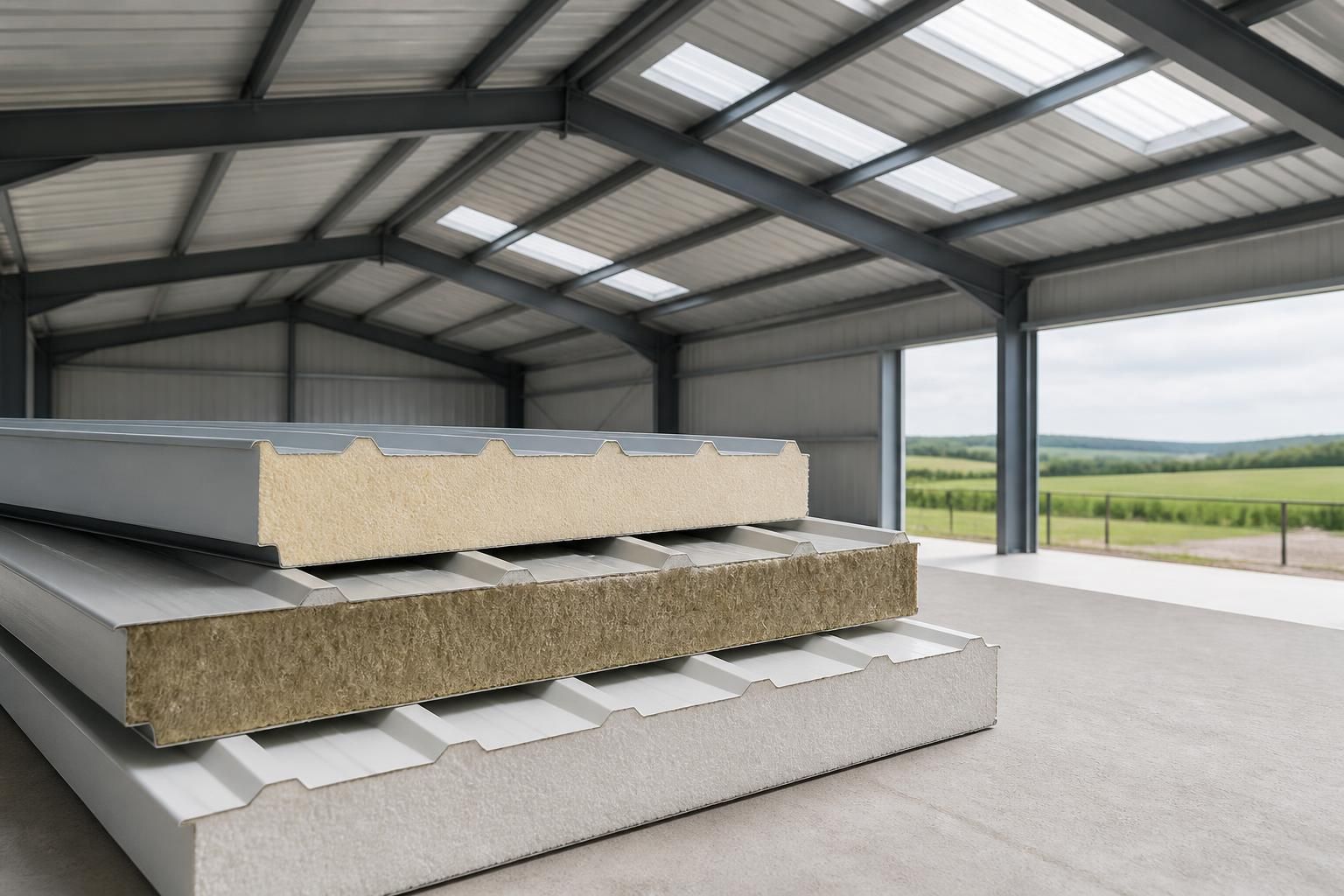
For most insulated roof panels, PIR is the best all-round core because it provides strong thermal performance in a relatively slim panel. Mineral wool is usually the better choice where fire resistance or acoustic control is the priority, while EPS can offer a more economical option when insulation requirements are less demanding.
PIR is generally the most suitable core for insulated roof panels when the main requirement is high thermal performance without excessive panel thickness. It provides an efficient balance for many agricultural and industrial buildings, but it is not automatically the best choice for every project. Mineral wool may be preferable where fire resistance or sound reduction governs the specification, while EPS can be appropriate where the thermal requirements are more modest and initial cost is a significant consideration.
PIR core is a rigid foam insulation with a high thermal efficiency relative to its thickness. This can be useful where roof build-up depth, eaves detailing, or internal clearance needs to be controlled. It is also relatively light, which can simplify handling and reduce the additional dead load placed on the roof structure. The exact thermal performance depends on the panel design, thickness, joint arrangement and stated manufacturer data, so the core name alone is not enough to confirm compliance with a required U-value.
PIR is often selected for enclosed industrial buildings, workshops, storage facilities and agricultural buildings where a continuous insulated roof is required. Its limitations should still be considered. Fire behaviour varies between products and constructions, and a panel should be assessed using its tested classification rather than assumptions based solely on the word “PIR”. Panel joints, penetrations, flashings and the supporting frame also affect the performance of the completed roof.
Mineral wool core is made from mineral fibres and is selected primarily for its fire performance and acoustic characteristics. It is a strong candidate where the building stores combustible materials, where insurers or building control require a particular fire classification, or where reducing the transfer of noise is important. Its greater density can also affect handling, support requirements and the loads considered in the structural design.
Mineral wool panels need careful detailing to prevent gaps or compression at joints. Water management is equally important: damaged edges, poorly sealed penetrations or unsuitable flashings can allow moisture into the panel and reduce the effectiveness of the roof system. The fire rating must be confirmed for the complete tested panel and fixing arrangement, including the specified thickness and joint details.
EPS core is a lightweight expanded polystyrene insulation. It is commonly considered where the project has less demanding thermal targets or where a simpler, lower-cost construction is being evaluated. Its performance must be checked against the required U-value, because achieving the same thermal target may require a different panel thickness from a PIR solution. EPS should not be selected on price alone where fire performance, acoustic control or demanding energy standards are important.
The most reliable comparison considers the whole roof system rather than the core in isolation. Review:
- the calculated U-value and the panel thickness needed to achieve it;
- the fire classification for the exact product, thickness, joint and fixing arrangement;
- the acoustic performance where machinery, livestock, rainfall or nearby activities could create noise concerns;
- the panel weight and its effect on handling, purlins, rafters and connections;
- the resistance of the facings, coatings and joints to the building’s internal conditions;
- the detailing around rooflights, eaves, ridges, verges, gutters and service penetrations; and
- the anticipated maintenance and the consequences of accidental damage.
Building use should guide the decision. A heated workshop or occupied industrial space will normally place greater emphasis on heat loss and airtight joints. A building with heightened fire-risk considerations should begin with the required fire classification and work back to a compliant panel system. An agricultural building may need particular attention to humidity, condensation, corrosive internal atmospheres and the effects of livestock or stored materials. Where noise is a concern, mineral wool deserves consideration even if another core provides a slimmer construction.
Condensation assessment is also essential. The core material, internal and external temperatures, humidity, ventilation, vapour control, panel joints and thermal bridges all influence the risk. An apparently high-performing core will not compensate for open joints, poorly sealed penetrations or inadequate ventilation. The roof design should therefore be checked as a complete envelope, with the panel manufacturer’s installation requirements followed precisely.
In practical terms, choose PIR when a slim, thermally efficient roof is the priority; choose mineral wool when verified fire or acoustic performance has greater importance; and consider EPS where the project’s thermal and fire requirements can be met with a more economical specification. The final choice should be based on the required performance of the complete insulated roof panel system, supported by technical data and project-specific design checks.
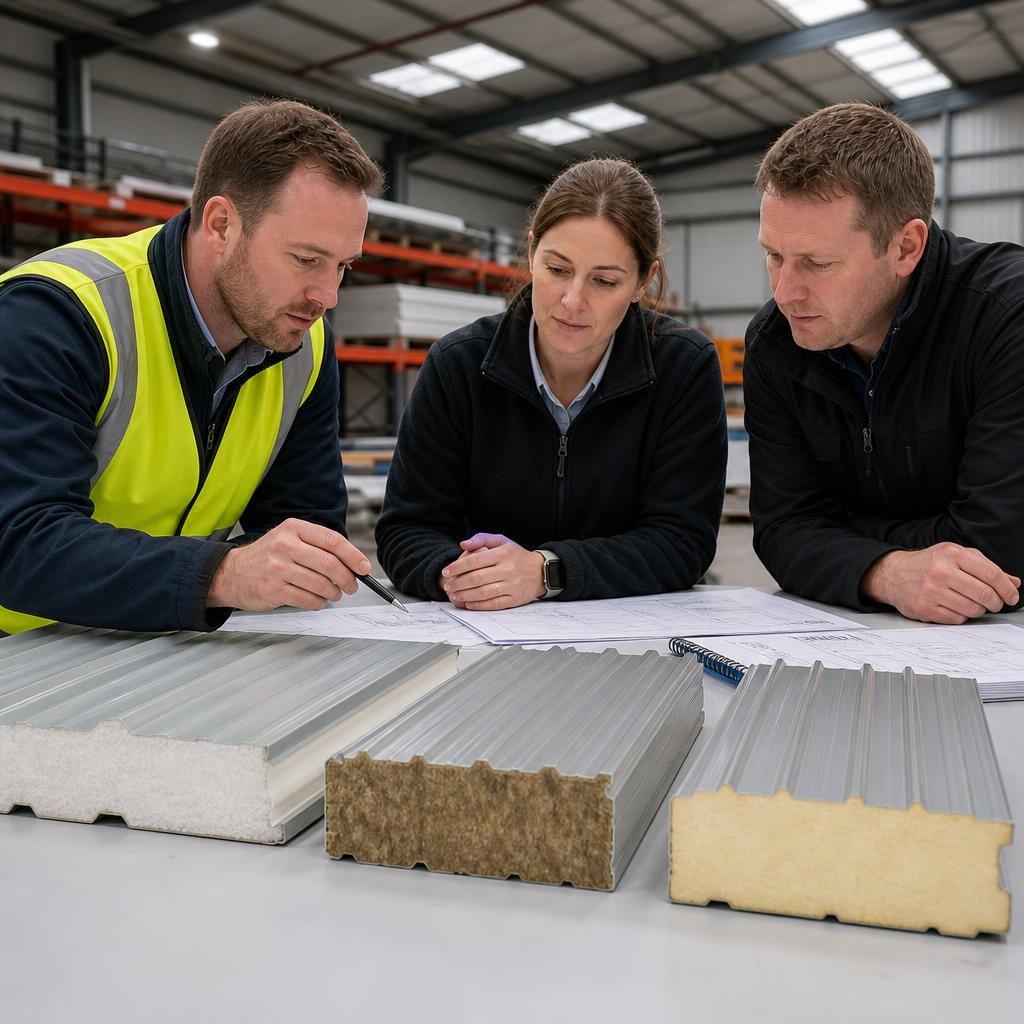
The best core does not always need to be used throughout an entire building. Where a project contains separate fire compartments, occupied areas, storage zones or spaces with different environmental conditions, each roof zone can be assessed against its own performance requirements. This may allow the specification to reflect the actual use of each area rather than applying one material across the whole roof.
Any change from one panel type to another must be treated as a designed junction. The interface should maintain weather protection, airtightness, drainage and the required fire separation, with compatible flashings, seals and fixings. The manufacturer’s details should confirm that the adjoining systems can be used together; selecting suitable cores independently is not enough if the transition between them creates a weakness in the completed roof.
Need Help Choosing an Insulated Roof Panel Core?
Share your building’s use, required thermal performance and any fire or acoustic criteria with Buildings UK Ltd for guidance on a suitable insulated roof panel core. The specification can then be reviewed as part of the wider roof design, including panel thickness, detailing and compatibility with the supporting steelwork.