What safety documentation should steel erection contractors provide?
Steel erection contractors should provide a site-specific risk assessment and method statement, supported by relevant lifting plans, inspection records and competency documentation. The paperwork should explain how erection activities, lifting operations, temporary stability, access and foreseeable hazards will be controlled.
Steel erection contractors should provide a documented safety package covering legal duties, site controls, equipment, temporary stability and worker competence. The exact documents depend on the contractor’s role and the project’s complexity, but a suitable package should allow the client, principal contractor and site team to understand how steelwork will be erected and how risks will be managed.
Construction management documents
For projects subject to the Construction (Design and Management) Regulations 2015, the contractor should identify how its work fits into the construction phase plan. Where the contractor is appointed as principal contractor, it may be responsible for preparing and maintaining that plan. Where another organisation holds that role, the steel erector should provide the information needed to incorporate its activities into the site-wide arrangements.
- Details of the contractor’s responsibilities and interfaces with other trades.
- Site rules covering access, exclusion zones, deliveries and coordination with adjoining activities.
- Emergency arrangements, including first aid, fire procedures, incident reporting and rescue arrangements.
- Records showing that relevant workers have received site inductions and activity-specific briefings.
Briefing records are important because a document is not, by itself, evidence that the workforce understood the controls. Signatures, attendance sheets or electronic records should identify who received the information and when.
Temporary works and stability information
Steel frames can be unstable before all permanent connections, bracing, cladding and slabs are complete. The safety file should therefore include the temporary works information needed to control that stage of construction. This can include erection sequences, temporary bracing details, connection requirements, limitations on loading and the conditions for removing props or restraints.
Where temporary works are designed or checked by an engineer, the relevant drawings, calculations, design assumptions and approval records should be available. The documents should also state who is responsible for inspecting the temporary arrangement and authorising changes. Substituting members, altering connection details or removing temporary supports without an approved review can affect the stability of the whole frame.
Lifting equipment and access records
In addition to the project’s lifting arrangements, contractors should provide current evidence relating to the equipment used. Depending on the operation, this may include:
- Thorough examination reports for cranes, hoists and other lifting equipment under the Lifting Operations and Lifting Equipment Regulations 1998.
- Inspection or examination records for lifting accessories such as slings, shackles, hooks and spreader beams.
- Equipment identification details so that certificates can be matched to the items on site.
- Inspection records for mobile access towers, platforms, ladders and other access equipment.
- Evidence that powered equipment is suitable, maintained and operated in accordance with the Provision and Use of Work Equipment Regulations 1998.
Documents should be current for the period in which the equipment is used. A certificate for similar-looking equipment is not sufficient if its identification number does not match the item being operated.
Work at height and rescue arrangements
Steel erection commonly involves work at height, so the documentation should explain how workers will reach connection points, move around the frame and prevent falls. It should address collective protection such as edge protection and platforms before relying on personal fall-arrest equipment. Where harnesses, lanyards or retractable devices are used, the records should cover equipment checks, anchor-point suitability and the method for recovering a fallen worker.
A rescue plan is separate from a general emergency procedure. It should explain who raises the alarm, what equipment is available, how an injured person will be reached and how the rescue can be completed without exposing additional workers to the same hazard.
Substances, hot works and fire controls
Where the work involves welding, cutting, grinding, coatings, sealants or other hazardous substances, the safety documentation should include the relevant control information. Safety data sheets, COSHH assessments, ventilation requirements, storage arrangements and suitable personal protective equipment may be needed. Hot-work controls should cover ignition sources, combustible materials, fire-watch arrangements and checks after the work is complete.
The contractor should also identify how steel components with sharp edges, coatings or contaminated surfaces will be handled. This is particularly relevant where fabrication, remedial cutting or site modifications take place after delivery.
Competence and training evidence
Competence records should relate to the tasks each person will perform rather than simply listing general site experience. Depending on the project, this may include evidence for crane and plant operators, slingers and signallers, mobile access equipment users, welders, harness users and those supervising the erection team.
Training records should be supported by an explanation of who is authorised to supervise the work and who can stop or alter an operation when site conditions differ from the planned arrangement. Agency workers and subcontractors should be included in the same verification process.
Changes, inspections and handover
Safety documentation should remain live throughout erection. If the sequence changes, ground conditions affect plant positioning, components differ from the design or planned access becomes unavailable, the contractor should record the change, assess its effect and communicate the revised controls before work continues.
At completion, the contractor should provide relevant close-out information. This may include records of completed inspections, outstanding defects, approved deviations, temporary works removal and any restrictions that remain in place. The information can then be passed to the principal contractor or client for the project’s health and safety file where required.
Before appointing a steel erection contractor, ask for a sample contents list for its safety submission and confirm when the project-specific documents will be issued. Check that the package identifies responsibilities, matches the actual frame and equipment, includes temporary stability and rescue arrangements, and provides a clear process for reviewing changes. Generic paperwork that does not reflect the building, site conditions or erection method should not be treated as adequate evidence of control.
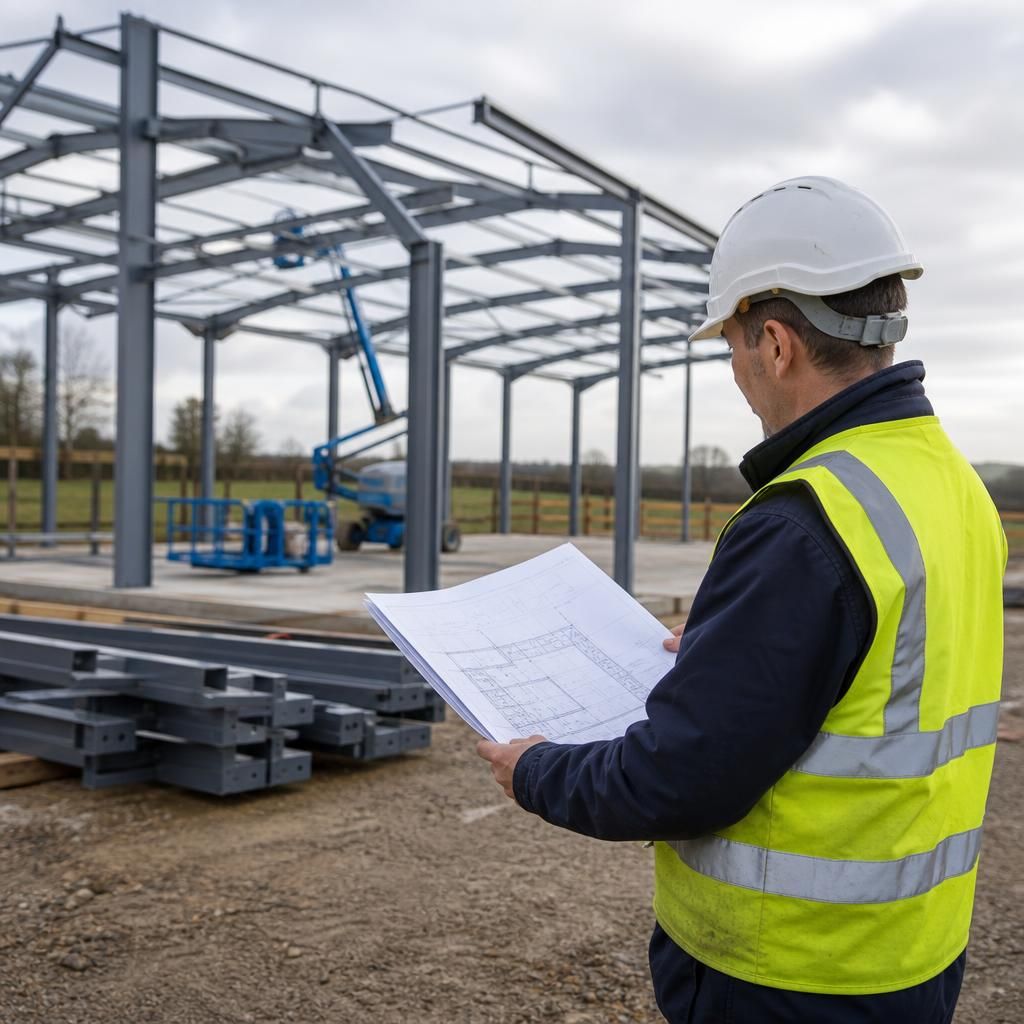
A safety document is only useful if the site team can identify the current approved version. The steel erection contractor should use document control showing the title, project reference, revision, issue date, author and approval status. Superseded method statements, drawings and lifting plans should be removed from working areas or clearly marked as obsolete to prevent crews relying on outdated instructions.
The approved information should be accessible to the people carrying out and supervising the work, whether in controlled paper copies or a suitable electronic system. Supervisors should be able to confirm that the documents match the frame, erection stage and equipment in use, while the client or principal contractor should be able to trace approvals and revisions. This provides a practical check that the paperwork being followed is the paperwork authorised for the current operation.
Discuss your steel erection safety documentation requirements
If you are comparing steel erection contractors, speak to Buildings UK Ltd about your project-specific safety documentation requirements before making an appointment. Ask the team to clarify which documents will be prepared for the proposed erection method, site conditions and responsibilities.